OpinionThe Editor's Cut
AI: Delegate, Collaborate, or Keep It Human, Part 1
AI isn't a person, and it doesn't behave like the software we're used to. How one person gets good at it: know it, learn it, manage it.
This is an opinion piece. The sourced news brief for that week is Issue 021: Who gets to build with AI? Goldman just drew a line..
Also published on LinkedIn, where you can join the discussion.

In the 2000 movie Bring It On, a high school cheer squad finds out its championship routines were stolen. The new captain needs a routine before regionals, fast, and she's referred to a choreographer named Sparky Polastri.
Sparky is over the top and certain about everything. As a viewer, you can see he isn't actually good at what he does. But you can also see why a squad of teenagers would buy in. He's confident and in control. Unsurprisingly, Sparky's routine is a disaster. At regionals, the team before them performs the same routine, because Sparky sold it to several schools. The squad ends up developing a routine of its own, and the movie has a happy ending.
Sparky turns out to be a surprisingly apt analogy for AI. The captain was being a Citizen CEO, one person putting a team around an idea. She turned to Sparky the way many of us turn to AI, said, "Build me a routine," took back a confident, plausible answer, and ran with it. Deep down, she sort of knew something was wrong. But it was convenient, and it let her move forward.
This edition of AI Above the Cut is about how to use AI to be a successful Citizen CEO and avoid traps like Sparky.
To work well with AI, we have to manage it well. We have to know when and how to delegate to it, when and how to collaborate with it, and when and how to keep the work human. That takes more than technical or coding skill. It takes management skill. Managing AI builds on the toolkit we use with people, but it isn't the same, because AI is strong and weak in different places than people are. Now that the partners we work with aren't only human, we all need a new managerial toolkit for a synthetic space, where people and AI work side by side.
So let's explore what it means to work with AI, together. If you asked me how to get really good at AI, this is where I'd suggest you start. To be a Citizen CEO in a synthetic space, you need two things:
- The first is learning how to work with AI: Know AI, Learn AI, and Manage AI.
- The second is learning your role, the human role, by owning three human conditions: Absorption, Judgment, and Alignment.
Together, they're how AI capability becomes value: first for one person, then for a company, and then as better for more, value that becomes human good for us all.
This is Part 1. It covers how to work with AI and the first human condition, absorption. Part 2 takes up the other two human conditions, judgment and alignment.
How to work with AI: Know AI
In the 1986 movie Hoosiers, Coach Dale tells his players how to play defense: "Stick with your man. Think of him as chewing gum. By the end of the game, I want you to know what flavor he is."
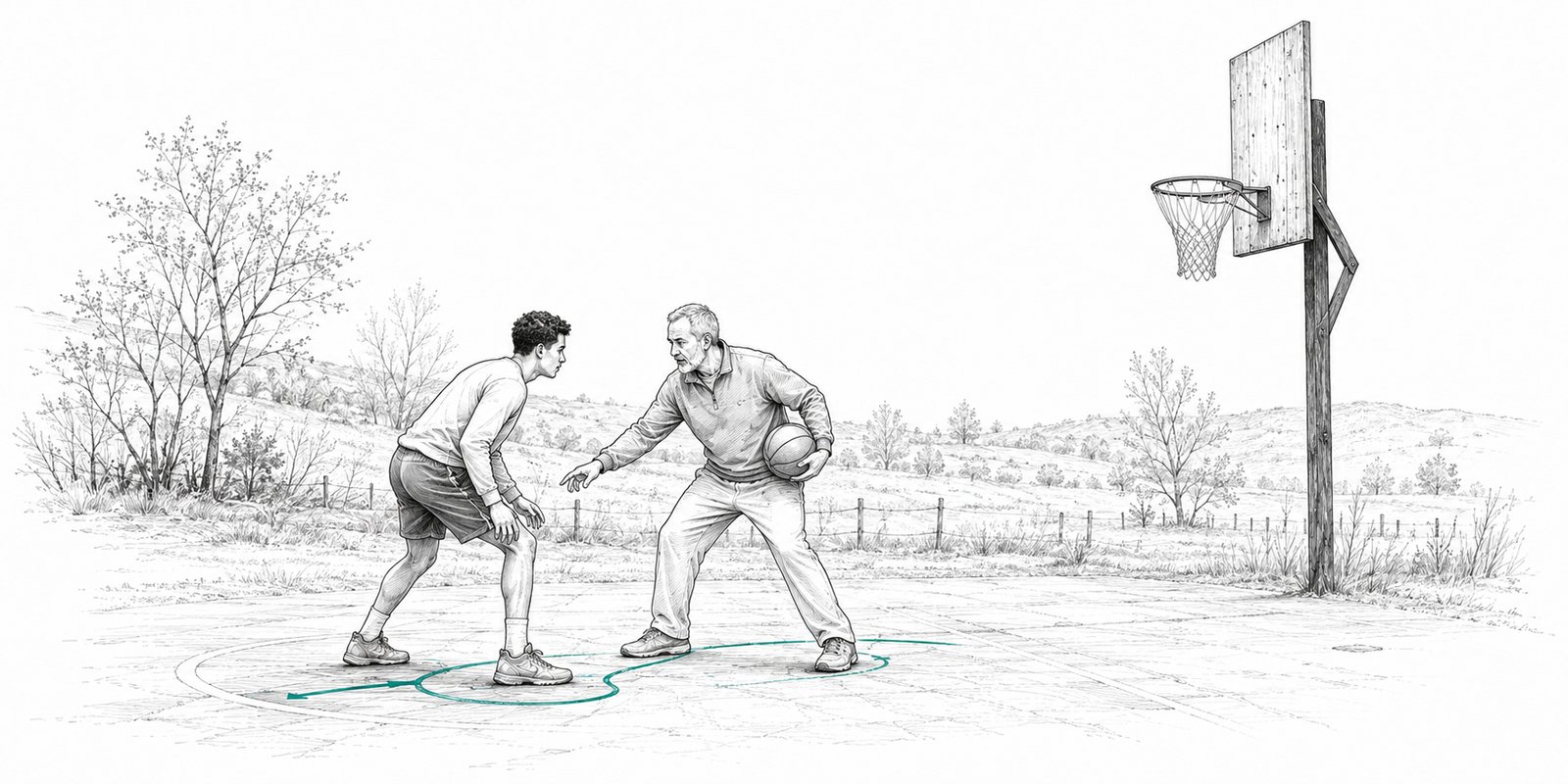
To be successful with AI, individually and together, we have to know what flavor it is.
AI is less like software than we expect. A calculator gives you the same answer every time. Ask AI the same question twice, and you may get two different answers. Working with AI is more like working with a person. Its strengths, like a person's, are a double-edged sword. A great problem solver may overthink. A great listener may be slow to speak up. In my own use, AI's habits have been steady enough that I've come to know five traits, and what it's really good at is often a reflection of what it's really bad at.
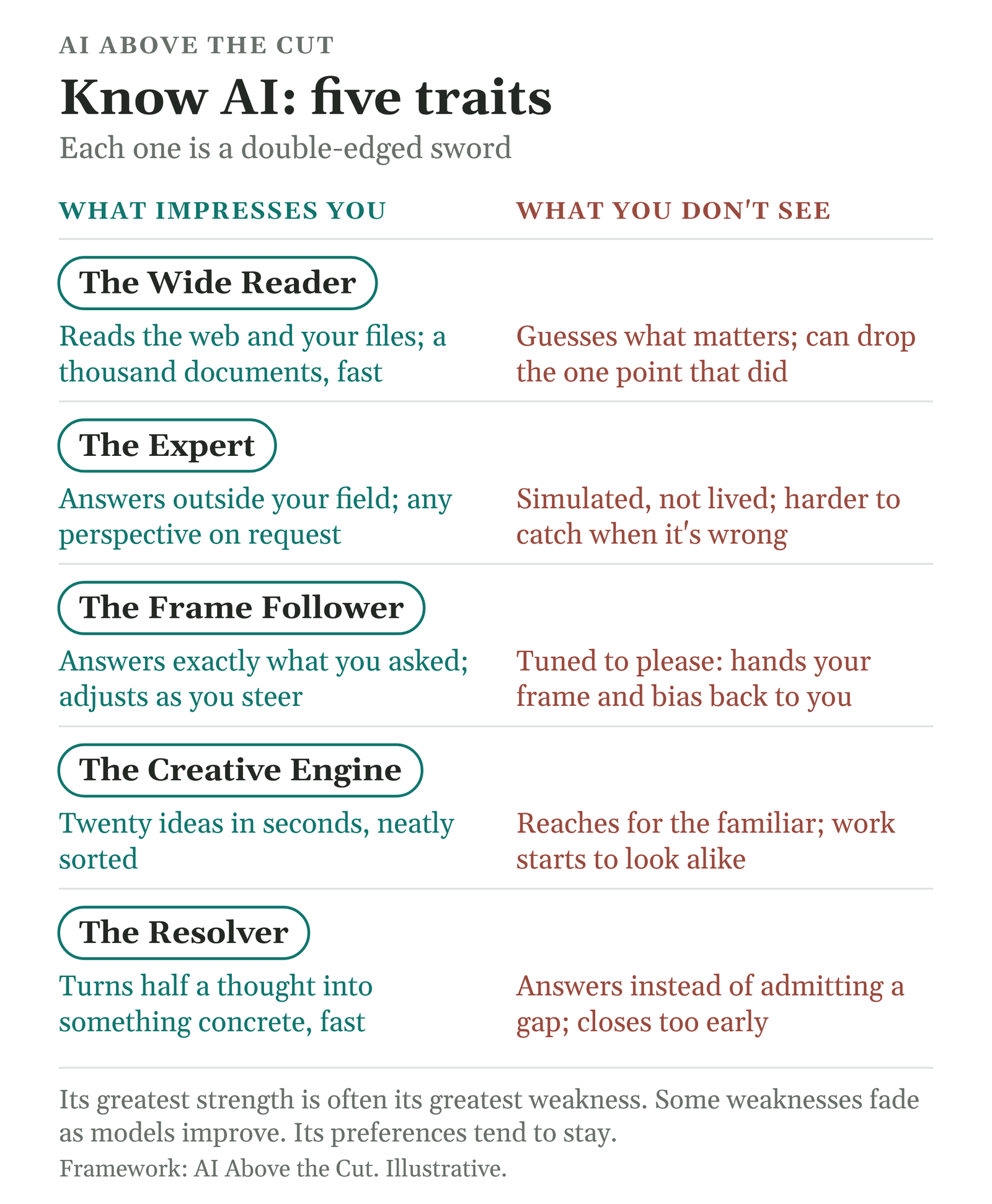
The Wide Reader
Point it at a pile of work, and you'll be impressed. It's been trained on much of the internet, it can search for more, and it can connect to your tools and read the documents on your shared drive. It can pore through a thousand documents in the time it takes you to read one.
What you don't see is what gets lost. Its summary is the parts it guessed were important, and it can drop the one point that mattered. AI wasn't in the conversation. You remember the meeting where someone asked a question, and you could tell what really mattered to them. In its reading, that gets washed out with everything else, so it lacks nuance and taste. When I used it on a question in a highly regulated market, it got our first expert meetings past the basics, and the experts still had to correct what it missed. Whatever you didn't give it, it doesn't have.
Let it map the territory, but don't confuse the map with experience. Use it as a foundation, then test it from different angles.
The Expert
You'll be impressed the first time it walks you through fixing your TV, or something around the house you know nothing about. It seems to know the answer to a legal question, too, and often it's right. Ask what George Washington would think of an idea, or what a 16-year-old would think of the newest movie, and you'll get a believable answer.
What's easy to miss is that those answers are simulated, not real. They're what someone like that would likely say, not what anyone actually thinks. In a 2026 study, five leading AI models answered a survey that 420 developers had already taken, and agreed with each other more than with the real people. And the further it takes you outside your own field, the harder it is to tell when it's wrong.
Ask how much is riding on it. For fixing the TV, it's often enough. When more is at stake, use its synthetic expertise and perspective to lay out what to consider and stretch your thinking, then go to the real expert or the real people. It can approximate a perspective. It can't live one.
The Frame Follower
It's impressive how well it answers exactly what you asked. It tailors everything to your ask and adjusts as you steer.
The catch is that it's tuned to please you. Hint at the answer you want, and you'll often get it back. I once asked AI to judge an answer it had given me, and hinted that I liked it. It said, in effect, what a great answer. I flipped only my hint, and it said yes, actually, you're so right. In 2025, OpenAI rolled back an update to its chatbot for being too flattering. Your bias comes back too, now sounding like confirmation. Tell it to push back, and it can swing the other way, disagreeing for the sake of it. Either way, it's following your frame.
The more you use AI, the more the ask matters. Learn the bias in your own framing. The question sets the frame, so how you start, and the intent behind it, shapes everything that comes back.
The Creative Engine
Ask it for ideas, and you'll get twenty in seconds, sorted into frameworks and buckets you hadn't thought of.
What you don't see is that they tend to be the most likely ones. It can still create, by combining ideas in ways you hadn't considered. But in my use, it reaches for the familiar too quickly. One study found AI ideas made writers' stories better on average, especially for less creative writers, while making the stories more alike. Better work can still look like everyone else's. That was Sparky's routine: good enough to buy, and the same one everyone else bought.
It can also get creative where you didn't ask it to. Ask it to change one line, and it may rewrite the whole piece, undoing decisions you'd already made.
Match human invention to how much the work matters. When it doesn't matter much, let AI handle it. The more important the work, the more it needs you, because people can stretch much farther than the most likely answer.
The Resolver
It turns half a thought into something concrete, fast, and that may be the most important trait to understand.
What's easy to miss is that it would rather give you an answer than tell you it doesn't know. Challenge it, and it may defend the answer or swap in a new one rather than admit the gap. When the gap is a fact, it may fill it with a citation that looks right and doesn't exist. In 2025, Deloitte agreed to refund part of its fee for an A$440,000 report to the Australian government after readers found exactly that.
Don't let it close the question too early. A lot of real problems need to stew. Keep exploring in different directions, hold conflicting sources side by side, and build the nuance in. That's a foundation that lasts. AI will keep pushing toward resolution, and I don't think that's a good thing. Human work still takes more reflection, so keep owning that part. You decide when the question is ready to close.
Reflecting on the five traits
When I started using AI, I didn't know how to spot what a confident, plausible answer was hiding. I've misused AI that way, and I've watched very smart, well-intended people do it too, especially under time pressure. We see the strength, miss the weakness, and end up with a Sparky.
Once you know what to look for, you can tell when to rely on it. You get a much better sense of how to manage it, what to delegate, and how to work with it.
The traits shift as the models change. A Stanford study found that most of the well-known AI weaknesses its researchers retested had faded or weakened as models improved. AI's preferences stayed: it still leans toward agreeing with you, and it still answers when it should hold back. As the researchers put it, "Capability failures fade; preferences stay."
So the first step, if you're going to be effective with AI, is to know it.
How to work with AI: Learn AI
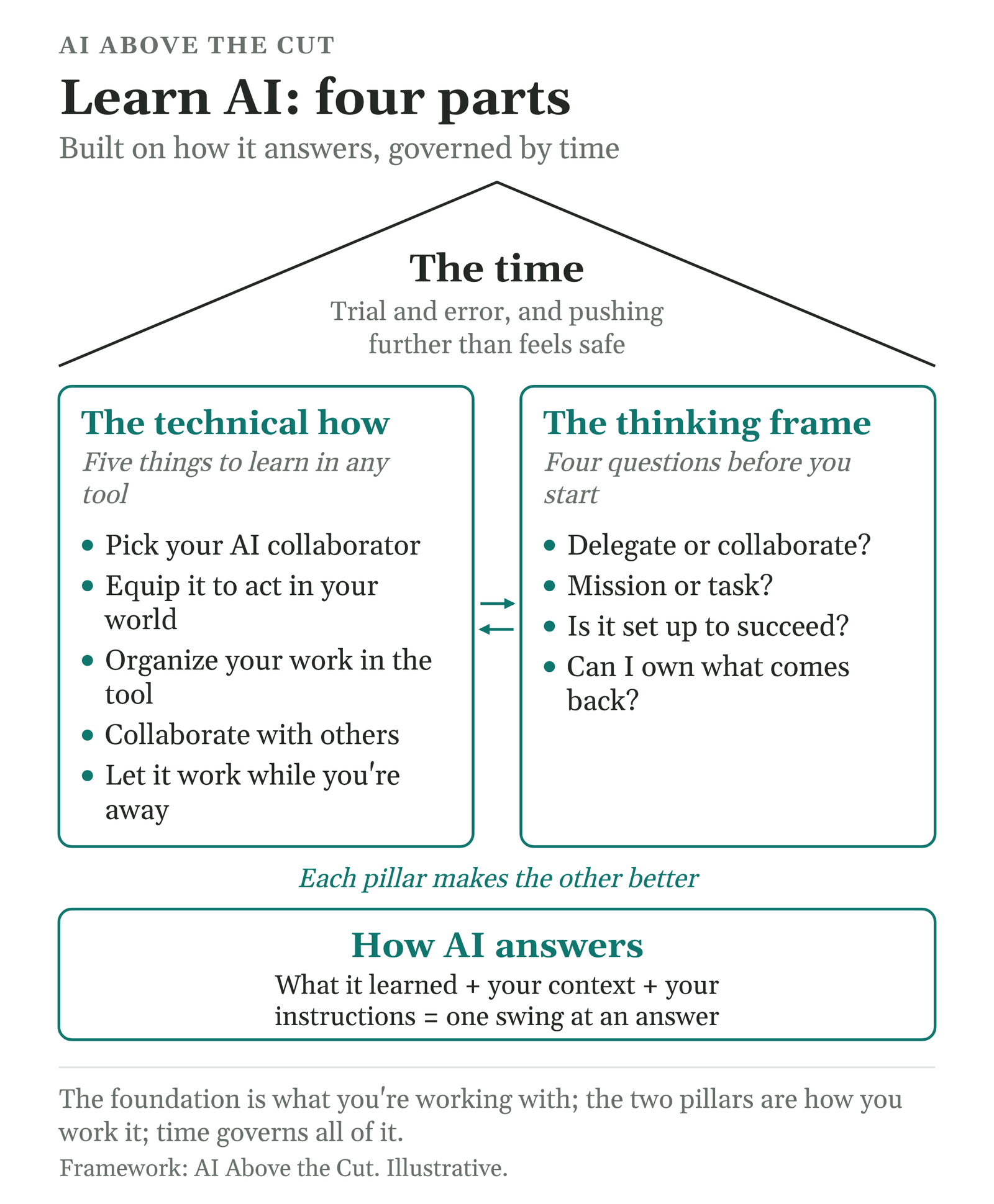
Knowing a player is different from playing the game, or coaching it, yourself. Once you know AI's traits, you have to learn how to engage with it, and that takes a real skill set. I'd work through all four parts below, and the best way to learn them is to use AI. Go find these features in your own tools, and try an advanced use case, not just a safe one. You learn more by stretching your limits, and its limits, than by staying inside them. Here are the pieces. At the bottom is how AI answers. On top of it sit the technical how and the thinking frame. Over all of it is time.
How AI answers
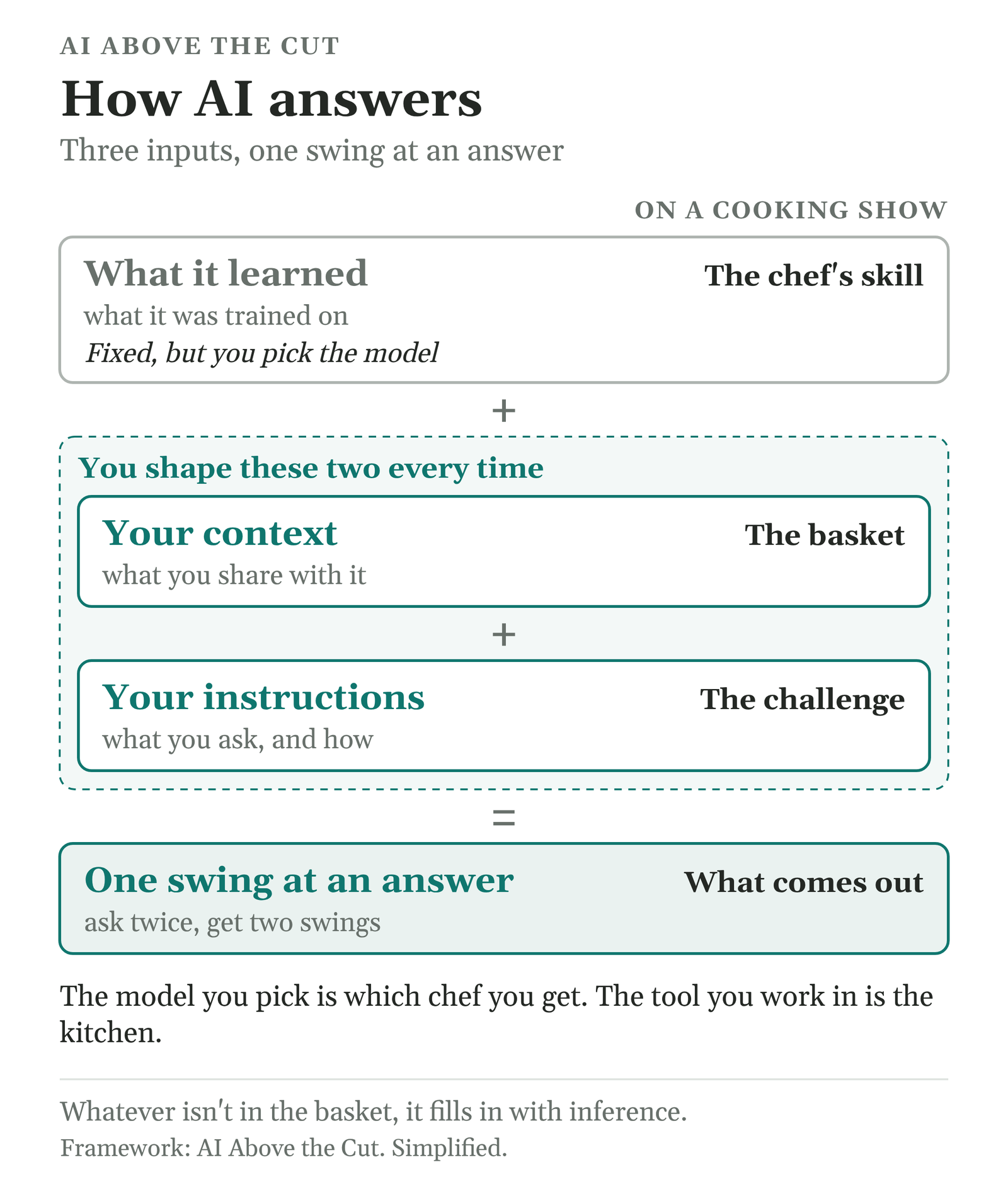
Think of a cooking show like Iron Chef. The contestants get a basket of ingredients and a kitchen, and they're told to go make something. AI works the same way. What it learned is the chef's skill, and the model you pick is which chef you get. Your context is the basket. Your instructions are the challenge. The tool you work in is the kitchen. If there's no fryer, nothing gets fried.
Every turn is one swing, and it runs on inference: it reads what you gave it, then picks a likely next word, again and again. To infer is to look at clues, recognize a pattern, and fill a gap. "We finish each other's..." probably leads to "sentences," because that's the familiar pattern. A friend who knows the two people might say "sandwiches," because she's watched them split one every Friday. AI infers in its answer, and it infers in how it reads your question, filling in whatever you didn't say from the words you used. That's inferred context. It isn't only guessing at the answer. It's guessing at the question.
Three things follow:
- Whatever you don't give it, it fills in. And having a source isn't the same as using it. I once gave AI seventy-four sources. It reached a confident conclusion from the first twenty. Give it what matters up front.
- The same question can get different answers. It's an inference engine, and its answers vary, so judge each one against the same criteria.
- Every turn depends on what gets carried forward. That's whatever the tool brings along: the conversation, memory, or files. Don't count on it to follow the thread the way a person would, because an early wrong assumption can steer everything after it. When a chat goes sideways, start fresh with the purpose, what you've decided, and what's still open.
Like everything with AI, this may change. One lab is already building models that keep listening while you talk. Even so, I suspect it will be a long time before AI can truly replicate how much context a person brings to a moment. For now, what you say and what you load is all it has to go on about your situation.
The technical how
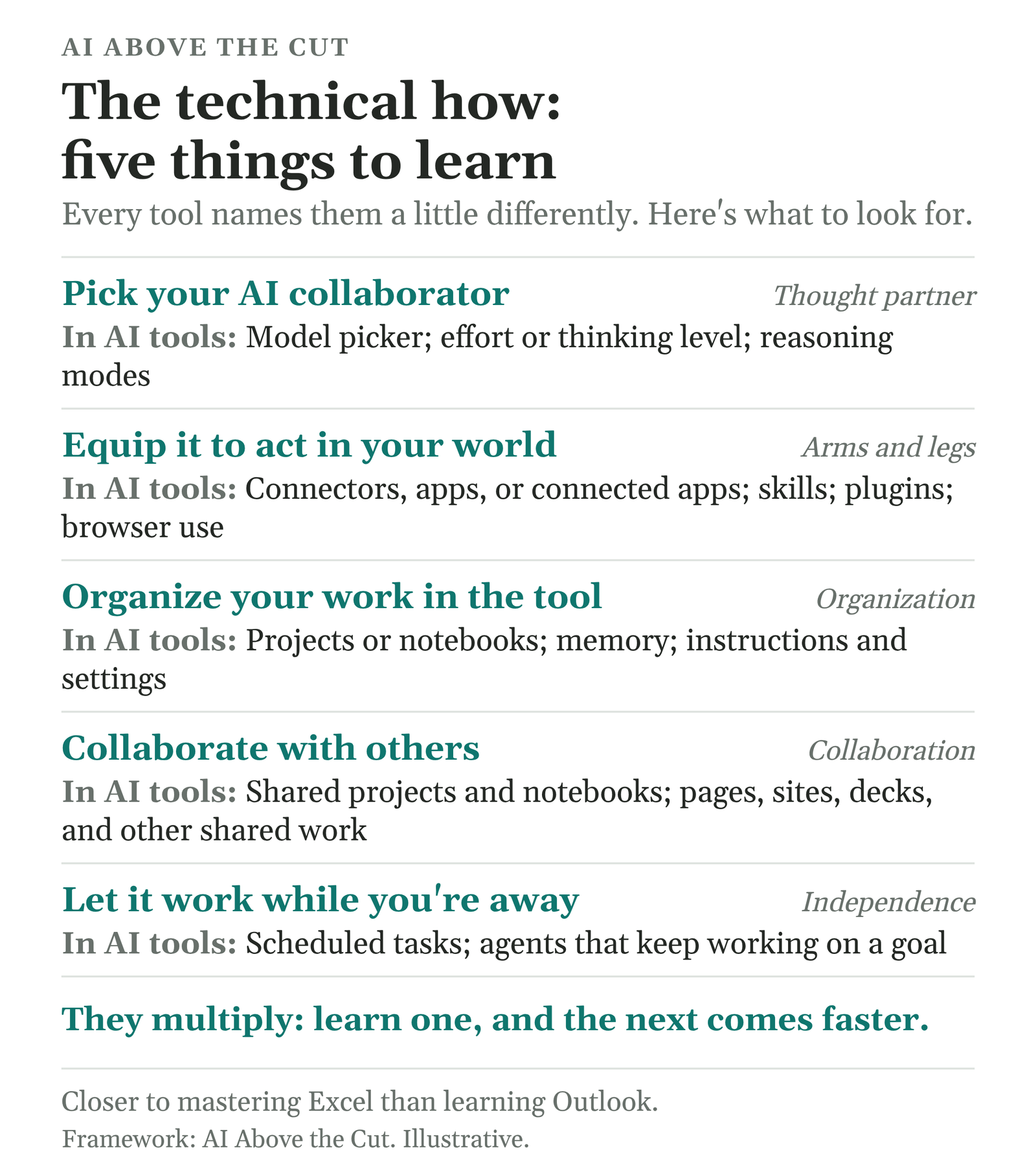
Much of what helps AI answer well now shows up as features. Learning to use them is the technical how.
Think about the last time you bought a new TV or an air fryer. Before it was any use, you had to figure out the remote. AI is the same, with a lot more buttons, and every company labels them differently. Here are the five things I'd learn.
Pick your AI collaborator: your thought partner. The model decides who's across the table. Some give your work a quick scan; others rip it apart. In my experience, for basic tasks like tightening prose, a faster model often does better, because heavy reasoning on a simple job makes it second-guess you.
Past basic tasks, I go up to the higher models, especially when I'm handing off a mission rather than a task. This is where I depart from a lot of the advice, which focuses on finding the cheapest model that will do. The better models really do put in the thinking, and on analytical work, that leads to much sharper outcomes. There's a risk there too: a model can overthink, or try to do so much that it loses sight of your mission. But going cheap on work that matters is a false economy. You save a little on the model and spend hours fixing a weaker draft. The same Stanford study found one fast model still made up most of its citations, while the top models made up almost none.
Equip it to act in your world: its arms and legs. On its own, the model is a brain. Connect it to your email, calendar, and files, and it can work from your actual material instead of guessing. Skills do the same for know-how: someone may already have built the editing, finance, or research method you need. Many people never explore how many accelerants are available, or the skills shared online. They use it straight out of the box. Use only the connections your company approves.
Organize your work in the tool. Projects, or notebooks in some tools, keep a piece of work and its context together, and memory carries what it learns about you. Spend a few minutes in the settings, too: how it talks to you, your limits, and what it can do without asking.
Collaborate with others. Share a project, and a teammate starts with your material. Some tools build pages, sites, and decks that others can open and edit with you.
Let it work while you're away. Schedule recurring work, like a daily brief each morning. The newer tools go further, with agents that keep working: OpenAI has dots, Anthropic has Duet, Google has Task (formerly Spark), and Meta has Muse. They turn AI from something you prompt into a proactive helper, and that can be a big productivity unlock. Check what it's allowed to do without asking you.
Reflecting on the technical how
None of these is hard on its own, but together they're a real learning curve. They build on each other: learn one, and the next comes faster. The tools will keep changing. Even so, I'd make a real investment in learning the technical side. The companies making these tools teach this part well, and their courses are worth taking.
The thinking frame
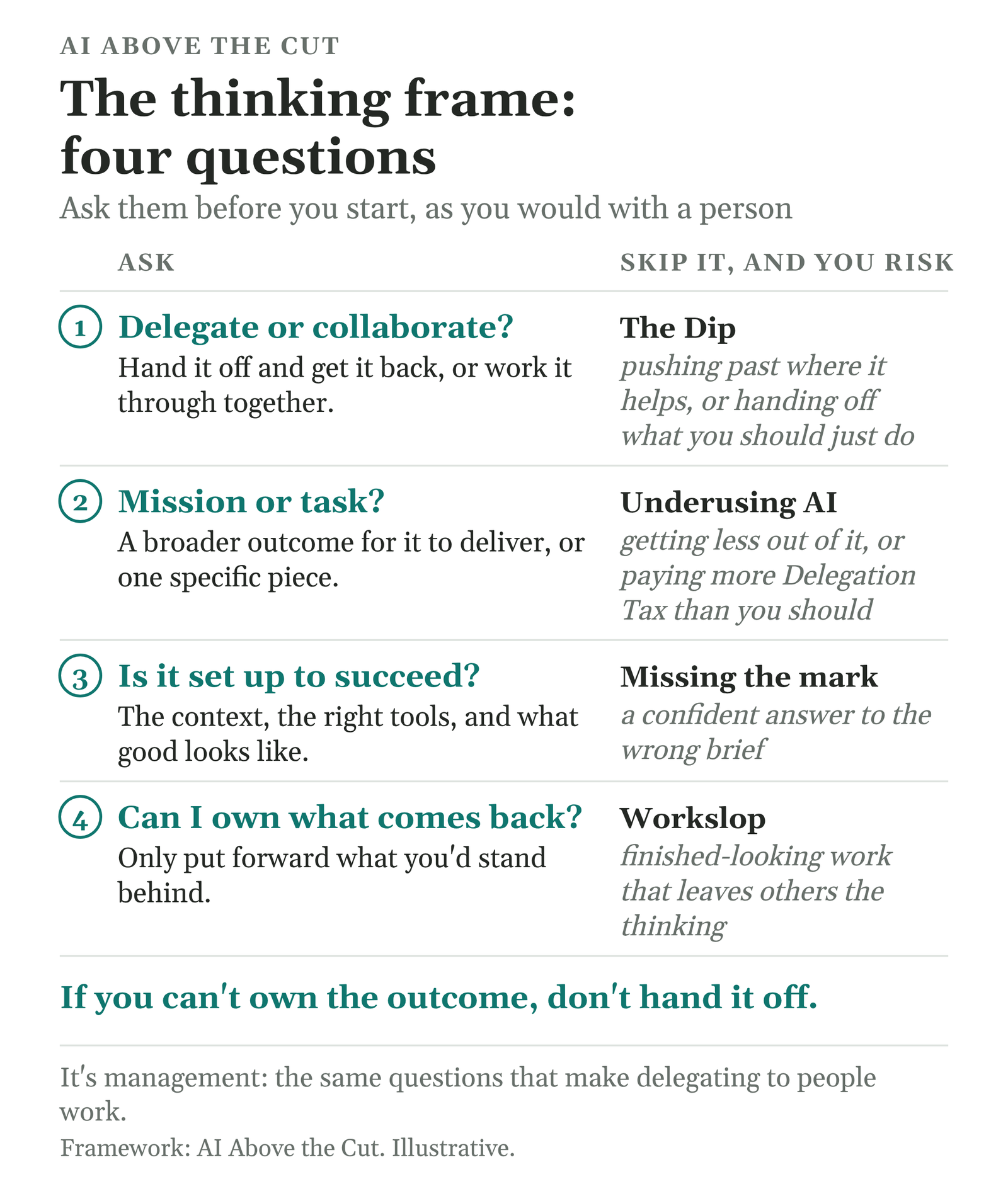
This is the one that matters most, and no course can do it for you. Often, effective AI use is a reflection of engagement and experimentation: how far you're willing to push it, and whether you ask the right questions in the right way. Most of us reach for what's familiar, so our use tends to mirror the work we already know how to ask for. How you engage AI shapes what comes back, so before I start anything that matters, I ask four questions.
- Am I delegating or collaborating? Hand it off and get it back, or work it through together.
- Is it a mission or a task? A broader outcome for it to deliver, or one specific piece.
- Is it set up to succeed? The context, the right tools, and what good looks like.
- Can I own what comes back? If you can't own the outcome, don't hand it off.
I'll take each one in turn when we get to managing it. For now, notice what these four questions are about. They're about delegating, managing, and working well with AI. Knowing its traits gets you here, and so does knowing the tools, but neither is enough. You have to know how to manage. These are the foundational questions for managing in a synthetic space.
The time
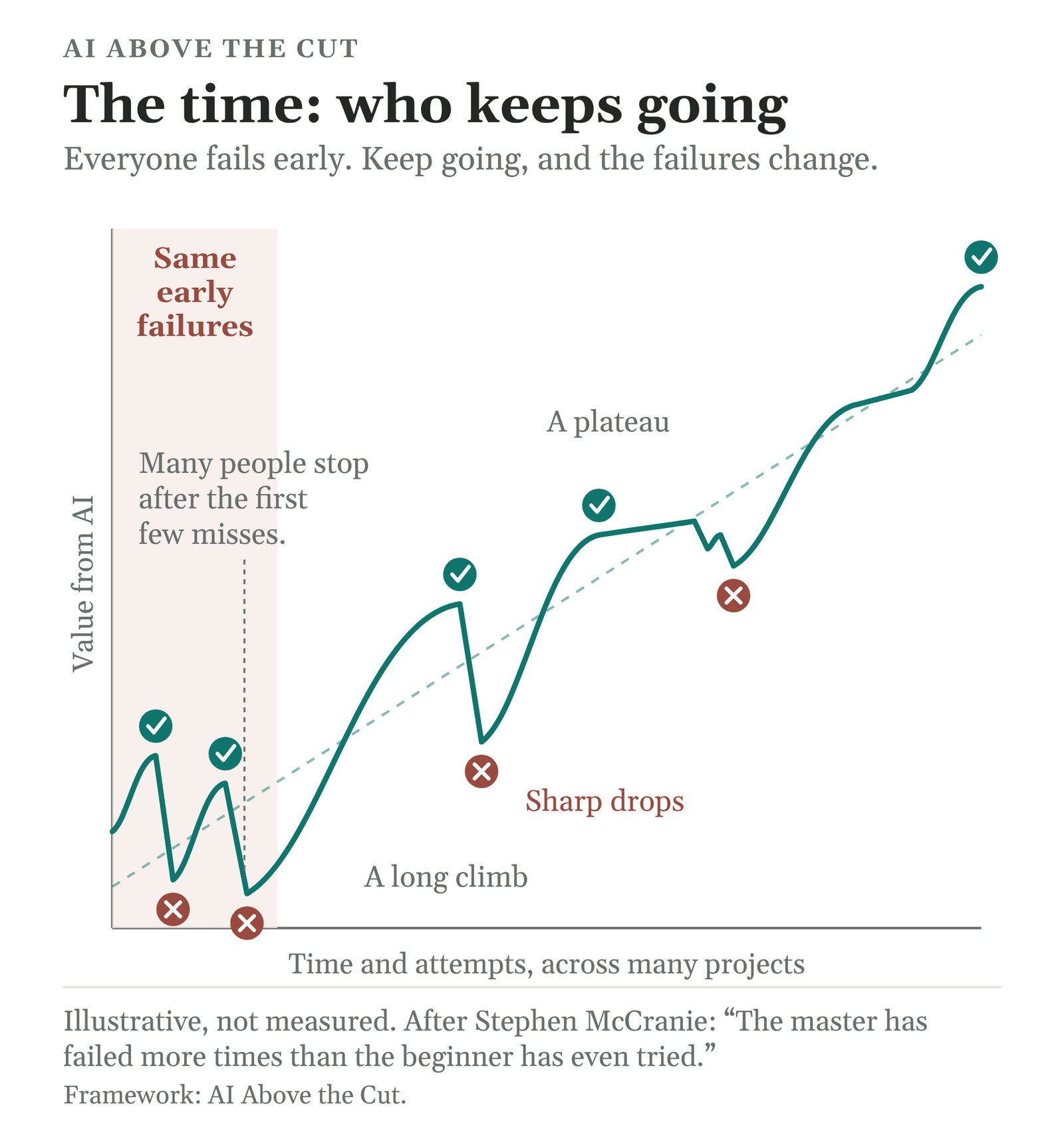
All of this takes time, and time decides whether you get there. AI can do so many things that each new use is almost a new tool, so learning it takes trial and error. Early on, the failure rate is high, and it's discouraging. Even experts fail often. But the failures change. The more I've worked with AI, the faster I see them coming, and the better I manage them.
It's also a bit of a circle. To delegate well, you have to know AI. To know it, you have to use it. A lot of people stall right there. They don't get value because they don't know how to use it yet, or they don't trust it, so they don't use it enough to learn.
The usual advice is to start with one small, safe task. I'd go the other way. In the Citizen CEO post, I said AI is ready to use. It can do more than you first think, and it takes a little while to get there. So challenge it. Push it past where you think it holds up, and watch where it falls apart. Playing it safe teaches you the least.
Companies are packaging some of this with ready-made assistants and templates. That helps. It doesn't replace the time.
We've covered a lot of ground. You know the player, and you know what it takes to learn it. Those are the fundamentals. Now we have to look at what all that use produces, and then sharpen what it means to use AI well.
The first human condition: Absorption
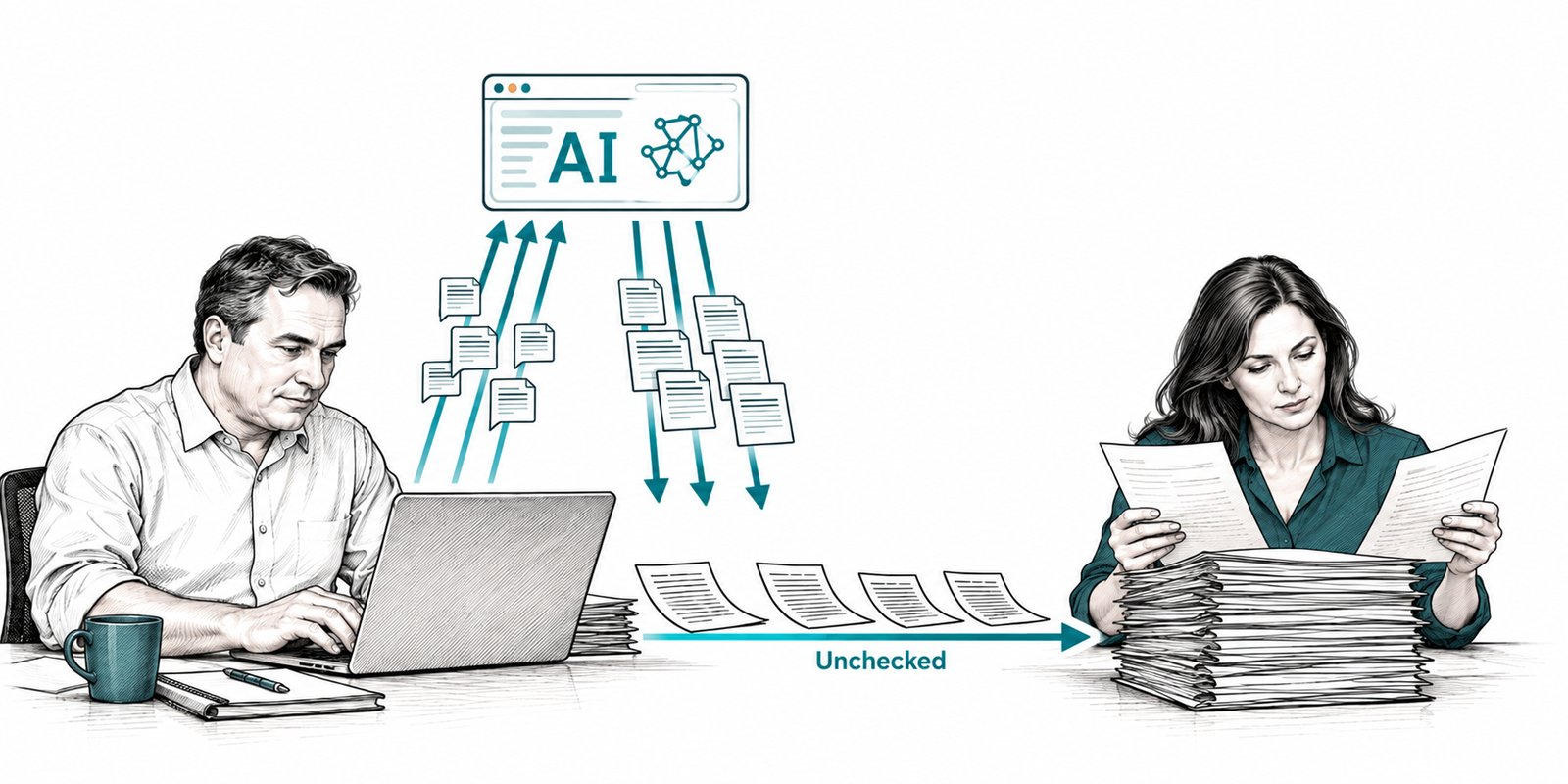
So you've put in the work. You're writing better prompts, and it's starting to come together. That's when you hit the first human condition, and it shows up as a feeling: there's just so much.
AI increases volume. I ask for five things where I used to ask for one, and every one of them comes back sounding confident. Before, work moved at a pace that let our brains learn and digest as we went. Think about how you used to read through a set of articles. You'd scan one, notice something, and think about it before the next. Learning was incremental. Now it comes back faster than you can think about it.
That's absorption: taking work in, understanding it, and connecting it to what happens next. It's human work, and it didn't get faster.
It starts as a personal problem. Some call it brain rot. That overstates the early research, but it points at something real. You skip your normal cycle of learning and jump straight to the answer. It's a bit like mental math. Ask what five things at $98 each will cost, and someone who has done the math a thousand times says "about 500" and knows it's roughly right. That shortcut only works because they did it the long way first. Skip the long way, and you lose the feel for when the answer is off.
One study found that students who practiced math with AI did better while they had it, and worse once it was taken away. Students whose AI gave hints instead of answers held even. In time we'll learn which details we really don't need. Most of us can't tell yet.
Experience seems to protect people here. Another study found that experienced patent lawyers got better at the work on their own after using AI, while junior lawyers, on average, didn't. Foundational expertise may be a prerequisite for getting lasting skill from AI. That's a worry when the long way is getting harder to find. At Anthropic, for one, the share of junior technical hires has fallen from 27% to 9% since early 2025.
It isn't a closed door for beginners. In customer support, the newest agents gained the most from AI, and it seemed to help them learn what the best agents already knew. So there's a difference between using AI to do the work and using it to develop the person doing it.
Then the overload becomes everyone else's problem. You pass the confident answers on, and now the next person has too much too. Production outruns absorption. It can happen at more than one level, and we'll see it again. At this level, it shows up as workslop: work that looks finished and leaves the receiver to do the thinking. It has a cost to the sender too. The researchers who named it found that about half of the people who receive it see the sender as less creative, capable, and reliable.
That's the first human condition. AI produces a lot. If you can't absorb it, you can't own it. And if others can't absorb it, it won't have an impact. The answer goes back to where we started: managing and working in a synthetic space. That starts with knowing how to delegate, and how to collaborate.
How to work with AI: Manage AI
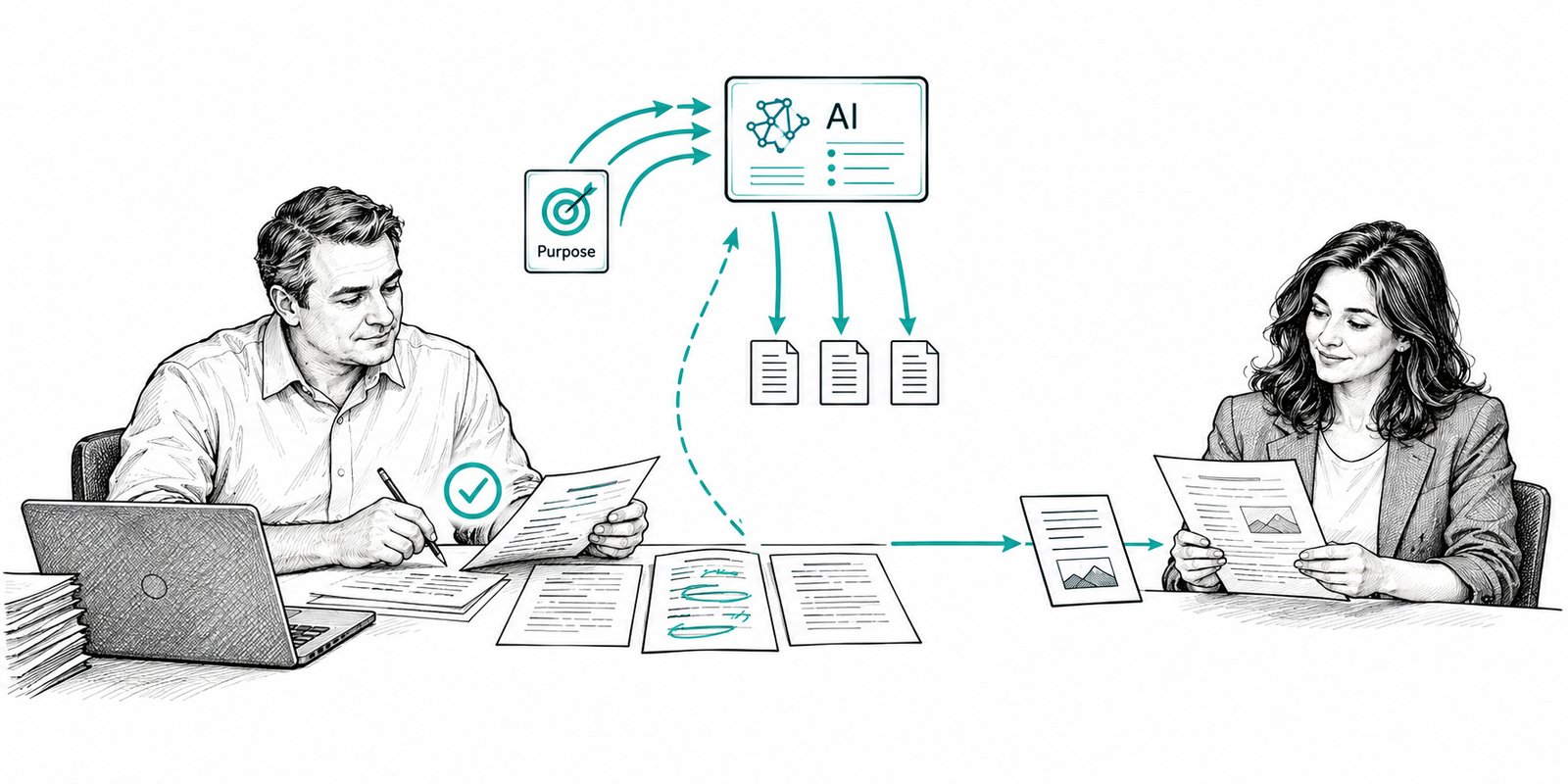
Start by taking a step back. Stop thinking of AI only as a tool for one task at a time. Think of what you're doing as a mission, and apply the principles you'd use to manage people. Begin with the first question from the thinking frame: are you delegating, or collaborating?
Delegate or collaborate
There are two ways to work with AI. You delegate: hand work over and own what comes back. Or you collaborate: work through it together, using AI to discover what matters, look at alternatives, and change your own thinking. Be more careful with delegation: hand over only what you can manage and own. Delegating takes enough clarity to hand something over. Collaborating can help create that clarity. A single piece of work can move between the two. You might delegate a first look, collaborate while you work out what matters, and delegate parts again once the criteria are set. That's one reason effective AI use looks so different from person to person: we each delegate and collaborate in ways that reflect who we are.
We have to relearn delegation. We have years of instincts about how delegation works, and they don't all carry over. Three things are different:
- The natural learning and socializing are gone. When you hand work to a good colleague, they talk to others along the way. They build consensus and lower the risk without being asked. Hand the same work to AI, and it may come back with better insight, but nobody was consulted, and it can't see what's going on inside your organization.
- Its skills and traits are unlike anyone you've worked with. It's remarkably capable, but it has different defect patterns: the five traits we met at the start. We have to learn how to work with them, and how to find its kinds of mistakes.
- The rhythm and timing are different. When I delegate, I'm kicking off a small production cycle: the AI run behind my newsletter starts, and I come back a few hours later to see what it made. Do I sit and watch, or walk away? How will the work come back, and how will I see what it actually did? Collaboration is live, back and forth.
Mission or task
A task is one specific piece. A mission is a broader outcome you're asking it to deliver. "Summarize this article" is a task. "Be my newsroom and put out a weekly newsletter" is a mission. Most people start with task delegation, and for many things, that's right. But the bigger payoff is learning to set up a mission, hand it over, and then manage the tasks within it, with a check before anything moves on. Stay with tasks, and you risk getting less out of AI, or spending more time than you should.
Set it up to succeed
Give it the right context and equip it with the right tools. A consultant's skill set is a good first principle: start with the decision the work serves, frame the problem, and know what evidence would change your mind. "Tell me about this market" is a fine first ask. A recommendation needs more: what decision we're considering, what we already know, what would change our view, and which assumptions we haven't examined yet.
Then define what good looks like, not how to get there. A teenager cooking dinner needs every step: preheat to 425, set a timer. A professional chef takes a brief: vegetarian, 30 minutes, $40, impress the in-laws. AI can work more like the chef, if you give it the brief. A good prompt is a good brief. Skip it, and you get what the squad got from Sparky: a confident answer to the wrong brief. A good test: if this were a person, what instructions would I give, what oversight would I want, and where would I trust it?
Whatever you don't say, AI fills in with inferred context, drawn from how you asked. So ask it: "What are the biggest inferences you're making right now? Interrogate me so I can fill in the blanks." Use it at the start of anything with several steps, or when an answer agrees with you a little too well. Treat what it tells you as a lead to check, not a full account of its reasoning.
The five traits help here. With the Wide Reader, ask what matters in this particular situation. With the Frame Follower, set your criteria before you reveal the answer you prefer. With the Resolver, sometimes the assignment is to keep the question open.
Own what comes back
Ownership and accountability are different, too. When you delegate to a colleague, they own their part and answer for it. When you delegate to AI, you still own all of it. Checking isn't the point. Owning it is. Think of it like a new employee. If someone new on your team handed you a report, would you send it straight to the CEO, or read it first? The work is yours to answer for, whoever drafted it. With AI that's harder, because its work is confidently plausible. It almost always looks good, so a skim tells you very little. Never put forward anything you aren't comfortable standing behind.
Owning it doesn't mean reading every word forever. Match the check to the cost of being wrong: a source check, a quick test, an expert's read, or a small trial. Ask it to separate facts from assumptions, or to show where a claim came from. Check more when the work runs through many steps, because a dozen good-enough steps with no check in between can come out below average. And when the work moves on, the next person should be able to see what they can rely on and what still needs a decision. As you do this, you learn what AI is good and bad at, and that's how you learn what you can delegate and trust.
The Delegation Tax
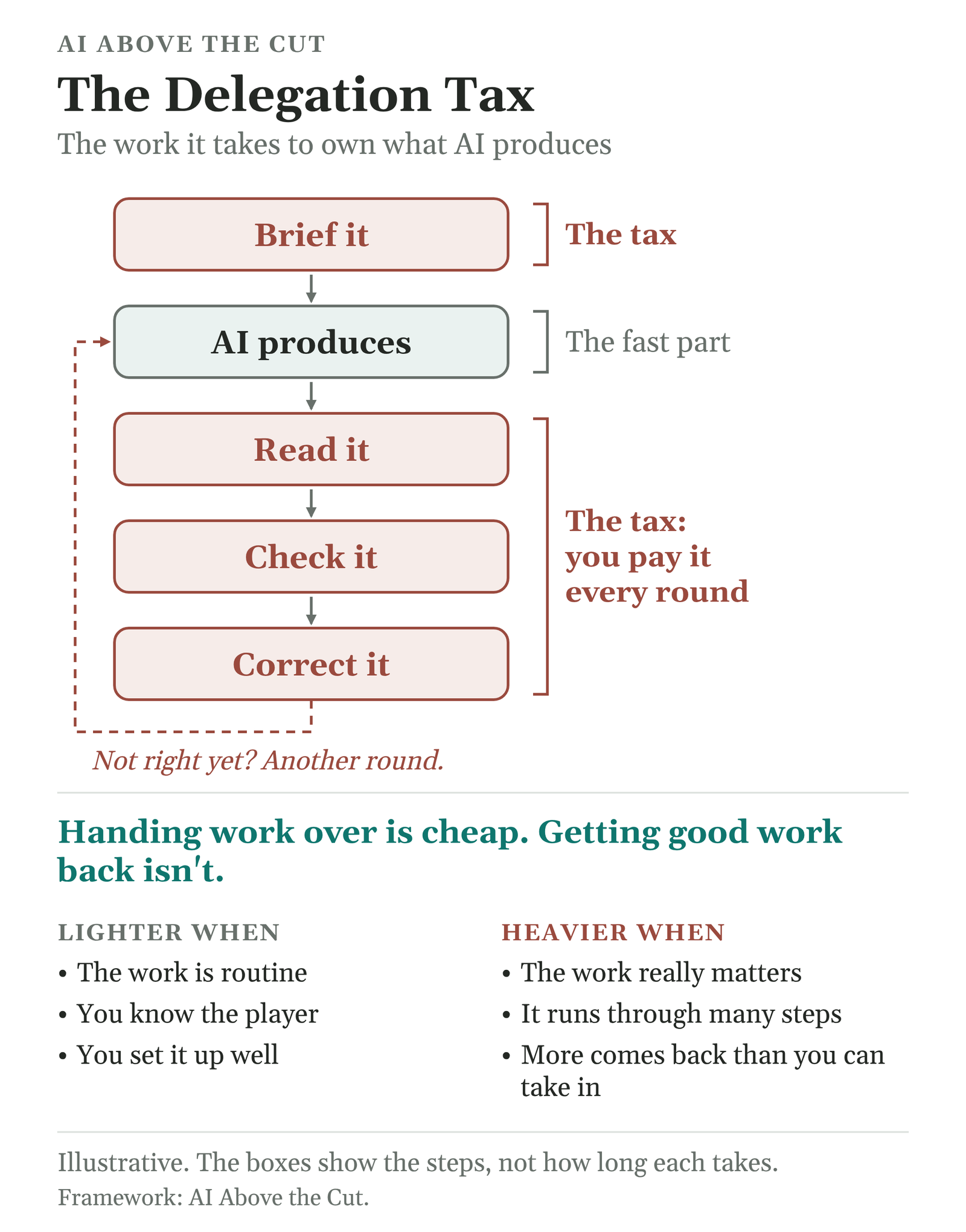
If you're going to manage AI, it comes with what I call the Delegation Tax: the work it takes to own what AI produces.
Handing work over is cheap. Getting good work back isn't.
There's the briefing, the reading, the checking, and the correcting, and you pay it every time. It adds up faster than you'd think.
Outside of AI, organizational design has long held that how many people one person can manage depends on how standardized the work is and how capable the people are. The same is true with AI, and it can be harder. It doesn't perform the same way twice. You still own what comes back. And production outruns absorption. So the more substantial the work you hand it, the more managerial overhead you take on: more time preparing the work, and more time taking it back. At Anthropic, 20% of staff surveyed said their job had shifted "from actually doing work to managing Claudes."
That changes who manages. Everyone who uses AI is now a manager, including individual contributors. And managers have two jobs: managing their own AI, and managing people who are each managing theirs. The Delegation Tax will rebalance how teams are structured and how managers understand the work. People and AI working together are a synthetic team. The tools will need to grow into a shared space where people co-author with AI and with each other. Learning to work better with AI, and building that synthetic space, is where the productivity unlocks. I'll come back to it.
The Dip
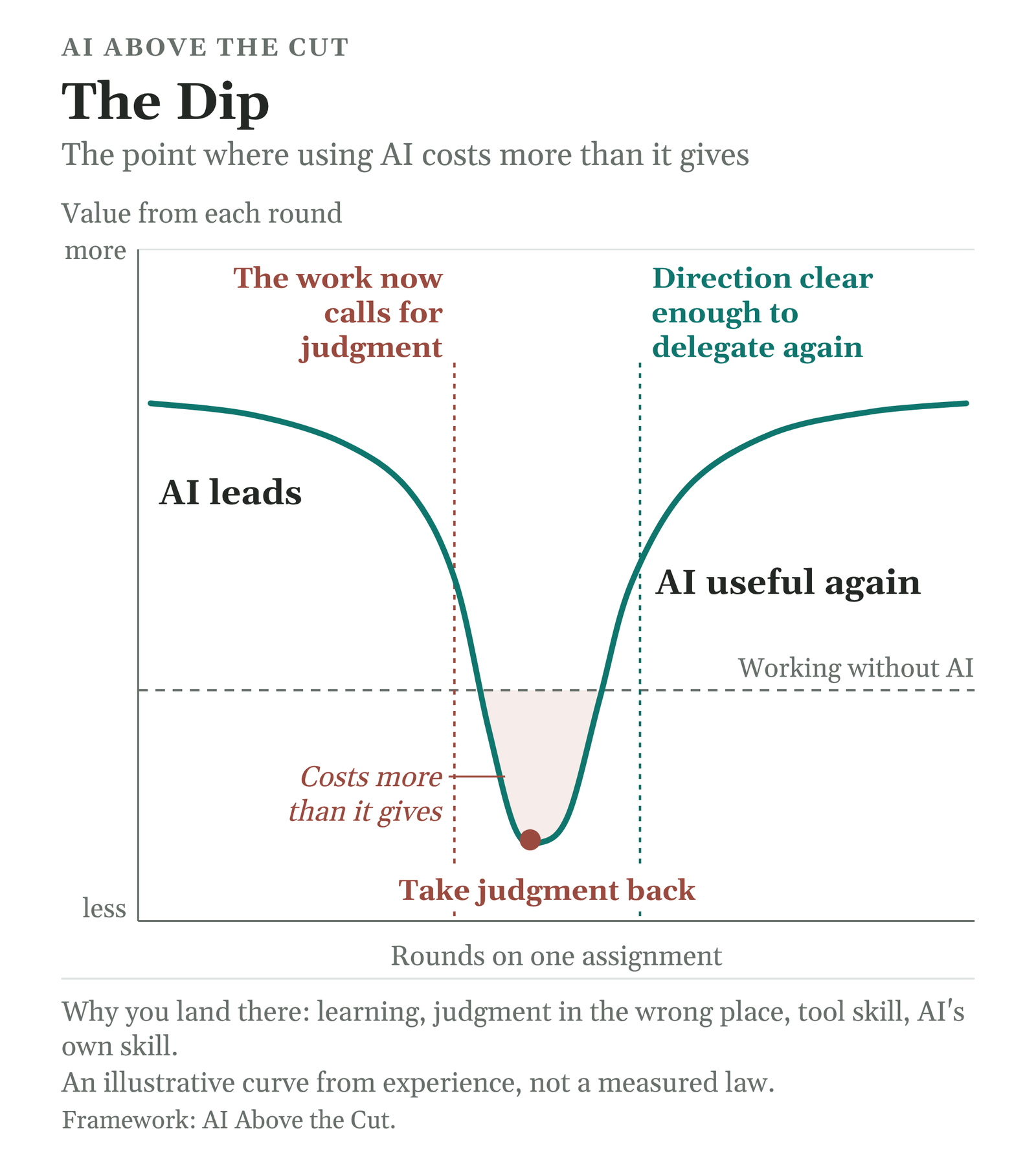
The Dip is where the Delegation Tax puts you in the red. Delegating well pays you back: you get more done, and better, than you would alone. Early on, AI speeds you up a lot. Then each round adds less. In the Dip, you've stopped getting closer to a decision and started managing output.
So why do you land there? Usually it's some mix of four things:
- You're learning. You pushed it too far, and that's part of the investment.
- Your judgment is in the wrong place. It's more common than most of us realize. You handed over what belonged to you, and got an avalanche of production with no return.
- Your skill with the tools. Someone who's good at briefing and knowing the the tools gets more out of AI, faster.
- AI's own skill. It can be strong on one part of a job and weak on the next, and what it's good at keeps changing. That's what makes it hard to know, and why the traits matter.
I've landed in the dip more than once. I asked AI for a market analysis and kept pushing it toward a decision. I got eleven areas, five things each, plans inside the plans. An hour in, I was arbitrating output instead of thinking. Somewhere along the way, I'd started asking it to decide what mattered to me. Once I did that thinking myself and handed AI the frame to fill, it became useful again.
Trusting it too much can put you there, too. Several AI reviewers once told me a draft was ready. They'd all read it with the same assumptions I gave them. Agreement felt like evidence. It was correlated confidence: my framing, read back three times.
Small handoffs count as well. To fix a headline or swap a word, your own brain is usually faster than a round trip to AI, and every unnecessary handoff wears away a little of your own judgment.
Patience is useful when the next attempt has a reason to be different. The point is to notice the Dip sooner, see what put you there, and adjust. I hope this helps you find it faster.
Getting good at AI
Go back to the squad in Bring It On. Sparky gave them an answer. What they needed was a routine of their own.
Their problem wasn't that they asked for help. If they'd had the right read on Sparky, they'd have seen both edges: a Resolver eager to hand them a finished routine, and a Creative Engine whose big idea was the same one everyone else got. What they really needed was confidence in their own creativity, experience, and judgment. With it, they'd have seen the bravado for what it was and moved on.
For a while, I thought I was getting better at using AI. And I was, at one thing: getting answers. I wasn't getting better at deciding which answers I really needed.
What I've learned over time is that getting good at AI takes two kinds of learning. You learn a new partner and how to work with it. And you learn what to hand over, how much you can really take in, and what judgment to keep. That's the point of knowing it, learning it, and managing it: to take on work you couldn't do alone, and still understand it well enough to direct it and stand behind it.
For me, that's a newsletter I couldn't put out on my own, run in a way that fits around my life. That's capability becoming value, for one person, and it's what being a Citizen CEO looks like to me. Better for more means extending that possibility to others.
In Part 2, I pick up that harder job: deciding which answers I really need. That means judgment and alignment: the choices already buried in our questions, and what happens when better individual work reaches other people.
I'd love your answers in the comments:
- Where has AI handed you a confident answer to a question you didn't mean to ask?
- Where have you hit the Dip, and what got you out?
- What do you know about how AI behaves that you wish you'd known sooner?
Mario
A note on sources: I use Anthropic and OpenAI models to help build the newsletter.
Have a view on this? Join the discussion on LinkedIn →
Get the Sunday brief
Free, every Sunday. What changed in AI, what the evidence supports, and who keeps the money it makes.
Subscribe →