OpinionThe Editor's Cut
Work was built for two kinds of things. AI is a third.
This is an opinion piece. The sourced news brief for that week is Issue 018: Google launches Argon. Anthropic rethinks how its software gets built..
Also published on LinkedIn, where you can join the discussion.
This is my quick editorial on what rose above the cut this week. Three stories stood out to me:
- A reimagination worth learning from. What Anthropic's replacement for Git says about what we can now attempt.
- Who keeps the customer relationship? Amazon and JPMorgan are blocking outside AI agents from reaching their customers.
- Give applied AI its own budget line. AI is a third kind of thing, and the budget should show it.
At the end, a quick inventory of everything in this week's issue.
A reimagination worth learning from
Anthropic says seven engineers used Claude to help replace Git, the standard system for managing code, and move its main code base onto the new system in five months.
The company says its daily code changes rose from about 2,500 in May to more than 30,000 in September. Its existing system could no longer keep up. The team built a replacement, called Scion, for that different scale and way of working. (Primary source: Anthropic's account)
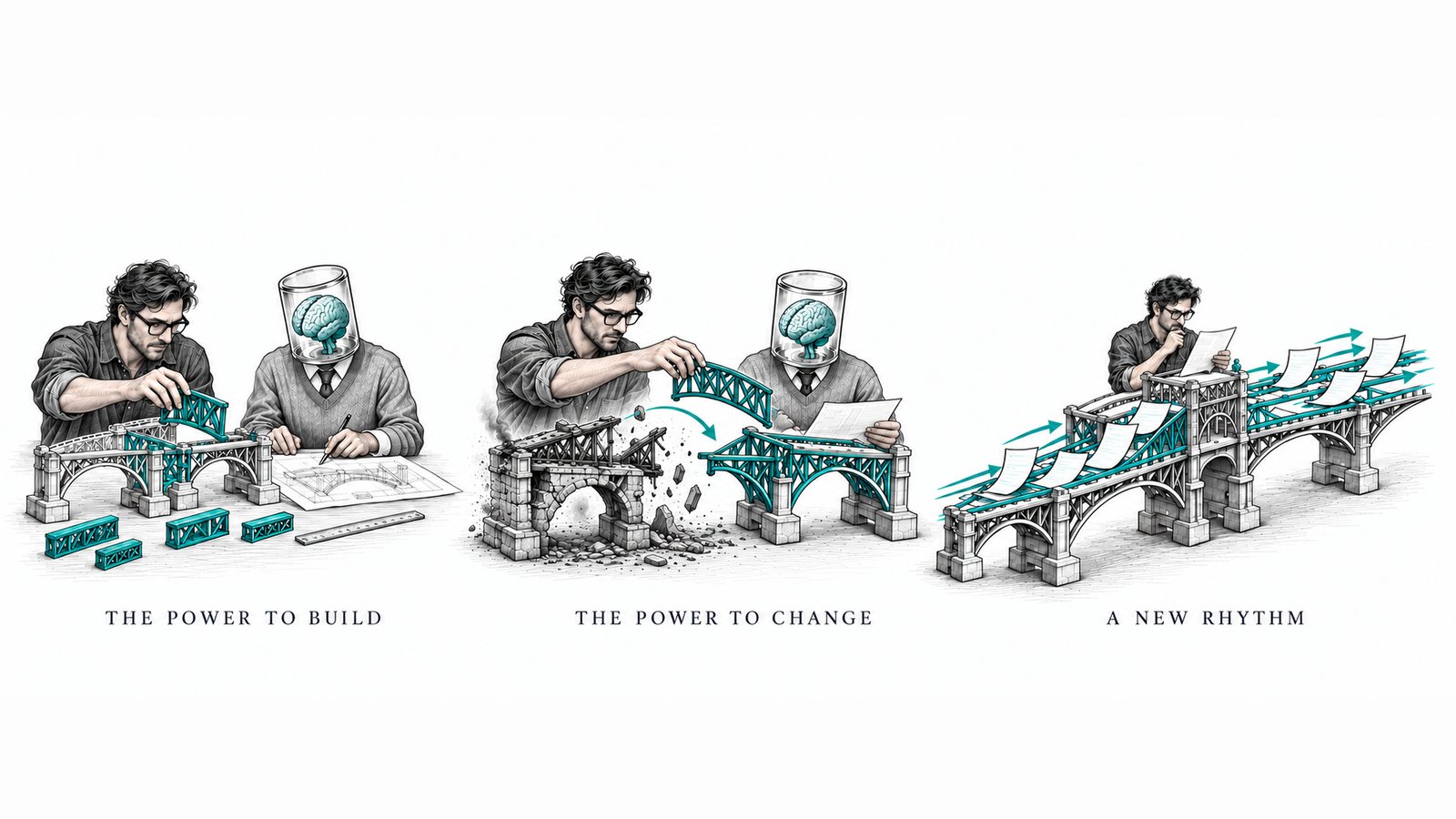
First, the power to build. A small team used AI to help create a system central to its own work. That is the promise I see in AI: people able to build things that would once have been beyond their reach.
Second, the power to change what already exists. Git is about as close to a universal standard as software has. Linus Torvalds released it in 2005, and about 97% of professional developers responding to Stack Overflow's 2022 survey said they used it. (Stack Overflow) It sits deep inside the daily work of a software team. Replacing it means changing tools, habits and the way work moves between people. We often look at a system like that and assume it is too connected to change. Here, AI helped build the replacement and do the work of getting there.
Third, a new rhythm of work. When production moves this fast, how do you review changes and keep the whole system sound? The team building Scion still reviews every change request, but examines its intent rather than reading every line of code. Often, as Anthropic puts it, their role "was to tell Claude 'no.'"
Imagine being asked to approve this before it began. Would you replace something that deeply woven into your team's work? Would you trust seven engineers to build the replacement and move onto it in five months? Would you also change how their work gets reviewed?
For me, those questions are what make this story significant. They challenge assumptions about which changes are worth attempting, how much capacity a team needs, and how long a transformation should take. They also challenge the way we manage the resulting work.
Taken together, I see signs of a fundamental shift in what is possible. We may hold back on AI simply because our expectations have not caught up with what we can now attempt.
There are limits to what one case tells us. Anthropic publishes no defect rate, says Scion is not meant for general use, and has unusual access to AI for its own work.
The question it raises for me is about work more broadly: which systems and habits do we treat as fixed because changing them used to be too difficult?
Who keeps the customer relationship?
Agents can also change how customers reach a business.
Last month Amazon blocked Meta's Muse agent from shopping on its site. Amazon says outside agents should respect a service provider's decision about whether to participate. (Reported: Bloomberg, via The Star)
This week the big banks drew the same line. JPMorgan's Jamie Dimon said the bank is "not going to allow just any outside agent" into customer accounts. "You don't want rogue agents." Schwab said it blocks agents that log in with clients' passwords, and points clients to its own assistant, Charley. Both still allow some approved routes; what they shut is the side door. (Reported: Fortune · American Banker)
Other companies are setting limits too. Delta, for one, says it has no arrangement that lets an outside AI agent book its flights. (Reported: TechCrunch)

I used to put more weight on unique data as a company's AI advantage. That still matters. These stories make me put more weight on the customer relationship: who helps the customer decide and carries out the action.
Amazon's famous flywheel helps explain the stakes. Lower prices and a better experience bring more visits; more traffic attracts sellers and selection, while scale helps lower costs. (Primary: Amazon's explanation)
The customer relationship is what I think connects that experience to the next visit. If an independent agent becomes your starting point, Amazon might still deliver the product while someone else holds the conversation, learns your preferences and becomes your first call next time. The threat is being separated from the customer while still doing the work.
My read is that Amazon is protecting that relationship as well as its data. If AI makes it easier for customers to switch suppliers, earning the next visit could become even more important.
The answer I see is to use AI to improve the experience, then make that improvement available to more customers. Better service gives people a reason to stay: less effort resolving a problem, a clearer understanding of their needs, or useful help that was previously too costly to provide. Protecting the relationship and improving the experience belong together.
Give applied AI its own budget line
Work was built for two kinds of things: people and technology. Companies budget, manage and measure them separately. AI is a third kind of thing, and it needs its own place in the budget.
Workday, which sells HR and finance software to large companies, is signaling a big change in how it gets paid. It told investors its AI agents could reach "beyond the software budgets into the labor and services spend." (Reported: The Register) I think that is reasonable. AI may look like software, but it does work that people and outside services used to do. It delivers both kinds of value. That holds for companies selling AI as a service and for companies managing AI inside their own walls. It is a distinct kind of spending, and it deserves to be seen that way.
I would give applied AI its own line in the management budget: the AI consumed, its connections to company data and systems, and the means to supervise it. Each cost still gets its proper accounting treatment. The point is to see the whole investment, who owns it and what it delivers.
Each story points to a new space for work
Put the three stories side by side and I see the same shift. Each one shows a new space for work, where people and AI do the work together. I call it the Synthetic Space.
- It moves faster. Anthropic's engineers needed a new rhythm of work to keep up with what Claude produced.
- It can change more. Seven people rebuilt a system most companies would treat as fixed. That is the Citizen CEO idea: deciding what is worth doing, then directing the capability to deliver it.
- It can take over interactions people used to own. An agent can now hold the conversation between a business and its customer.
- It has to be paid for differently. It combines software costs with work capacity, so I would make the investment visible in its own budget line.
The goal I keep coming back to is Better for More: use AI to make work and service better, then extend that improvement to more people. I first wrote about the Citizen CEO and the Synthetic Space in my first editorial.
The test for all of it is whether it turns into better work and a better customer experience at a cost companies can sustain. More activity on its own will not settle it.
A note on sources: I use Anthropic and OpenAI models to help build the newsletter. Anthropic's account is its own, and the broader argument here is my interpretation.
Also in this week's AI Above the Cut
The full issue, with every source, is free at aiabovethecut.com. Here are the headlines.
The One Thing
- Google released Gemini 4 Argon; price doubles December 1
The week in three numbers
- $16.8B: Anthropic's quarter puts it near OpenAI's reported pace
- 2x: Argon's score in Google's own setup vs a generic one
- $3.5T: AI data-center spending Gartner says faces write-down risk
The Signal
- Eight states sued OpenAI; the FTC and EU are investigating
- Lenders and investors started pricing in AI risk
- Gmail's new AI Inbox has no admin off switch
- JPMorgan and Schwab block outside AI agents
- Kroger plans 3,000 corporate job cuts; Workday eyes labor budgets
The week in product
- Meta released new models, including a large downloadable one
- ChatGPT can now act on sites where you're signed in
The Margin-Proof Tracker
- Bank of America's AI savings figures still lack a method
The Synthesis
- How Anthropic rebuilt the system its own AI outgrew
Where the Minds Disagree
- Which AI test score should a buyer actually trust?
Get it in your inbox every Sunday: aiabovethecut.com
Have a view on this? Join the discussion on LinkedIn →
Get the Sunday brief
Free, every Sunday. What changed in AI, what the evidence supports, and who keeps the money it makes.
Subscribe →