OpinionThe Editor's Cut
Welcome to AI Above the Cut
What this newsletter is, why I'm writing it, and what I think is going on.
This is an opinion piece. The sourced news brief for that week is Issue 018: Google launches Argon. Anthropic rethinks how its software gets built..
Also published on LinkedIn, where you can join the discussion.
This is the first LinkedIn edition of AI Above the Cut.
I am certain we are in one of the biggest moments in human history, at least on the scale of the industrial revolution. AI brings with it enormous opportunity. It can fundamentally shift what we are able to produce, how fast, and by whom, in a way we have not seen before.
But my fear is that we are more likely to land on the wrong side of this moment than the right one.
That is not for lack of opportunity, and it is not because anyone wants or is pursuing a bad outcome. It is because the habits, systems, and deep assumptions we use to adopt AI were built for a world without it. And in our rush to use it, it is hard to find the pause and the foresight to adopt it well.
But I think we have agency. Turning capability into value, and value into human good, does not happen on its own. We all have the chance to author part of the future. That is what I'm writing for.
Where I'm coming from
My first real experience with generative AI came in March of last year, after a friend nudged me to try it. I was hooked, and I've used it most days since. For the first year, I was fascinated by the thinking and analysis it could do, but I struggled to turn that into anything I could actually make. In the last few months, that changed. I've been able to build and create things like this newsletter, which were impossible for me less than a year ago. At work, I'm inside a large company working out what AI means for how it runs. And I read about it most days, where every week brings another model, another rollout, another number.
Through all of that, I feel like I know AI, and I hold that with humility. I've spent much of that time applying it to the problems of knowledge work, and building teams with it. I'd like to share what I've learned from those experiences.
What I've learned is that AI has a strange shape. It has read almost everything and will work hard to resolve your question, but may know little about you and the problem at hand. It is technology, and it has many of the characteristics of technology. But to get it to produce the quality and capabilities you want, you end up treating it more like a person. You brief it, give it a role, correct it, and teach it.
We've all seen the intelligence it can bring to analysis, producing in minutes a first draft that would have taken weeks. We've also seen where it lets you down. It can be confidently plausible: a convincing answer that is sometimes right and sometimes wrong, amazing one minute and frustrating the next. I've watched people try to use it without knowing that. I've watched businesses struggle to turn it into results. And I've watched the bigger questions pile up: what it takes to build, what it means for jobs, and what it means for us when a machine can do things we thought made us creative or unique.
With all of that, I believe something with this much capability has the potential to unlock incredible good: better access to health care, food for people who lack it, time given back to families. It could solve problems we have lived with for generations.
I also think the fear I named at the start is well founded. But many of the constraints we work under are not constraints at all. They are assumptions, and assumptions are optional.
I'm excited to add to the conversation on AI. We're all working this out together. Even the experts in AI are navigating this change for the first time. I'm sharing what I'm learning, and I hope you'll add yours.
Two bridges to cross: capability to value, value to human good
Here is the frame I keep coming back to. Capability is not value. And value is not human good.
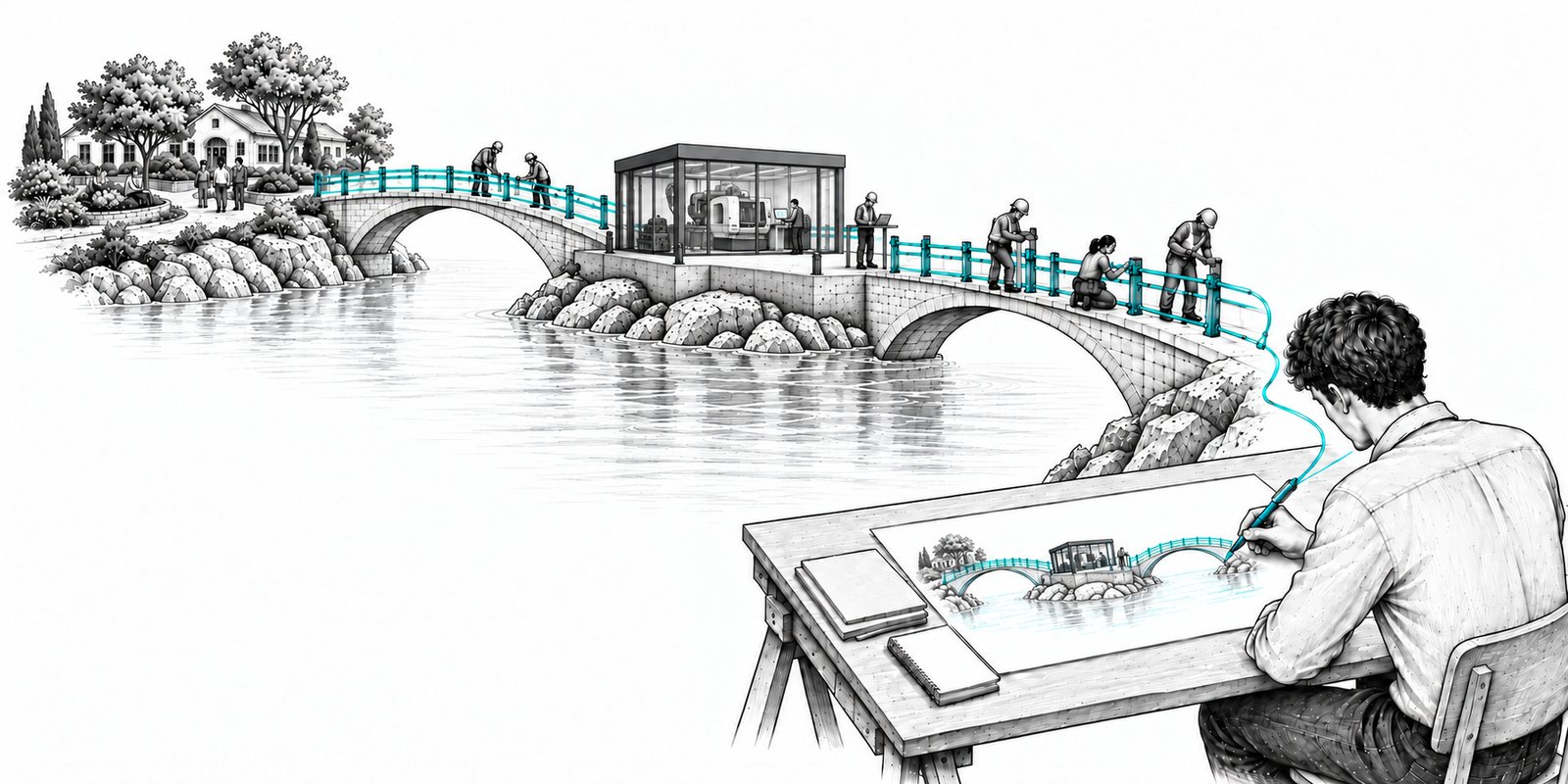
Those are two bridges, and we have to cross both. The first runs from capability to value: turning what AI can do into something a business or a person actually gets from it. A decision made better, a week's work done in an hour, a service that reaches more people. The second runs from value to human good: making sure that value ends up helping people, and more people than before. The people whose work changes should have a say in how.
In 1848, John Stuart Mill separated production from distribution. What gets produced is one question. Who receives it is another, shaped by laws, customs, and the choices people make. New technology can change what we are able to produce without deciding who will share in it.
Neither bridge is crossed by accident. Each takes intentional innovation, intentional design, and intentional action. It is often a long journey, with a lot of missteps along the way. That has been the pattern of creative destruction: old ways break, new ones form, and people have found their way across when they set out to.
Underneath that journey, from today to the future, is a question of agency and authorship. How do I hold the pen? How do I take part in writing what happens next, instead of waiting to read what got written? Understanding what is going on is the foundation for that, and it is why keeping current matters. But I also want to offer perspective on what it means. So that is the journey here: how we get AI capability across the first bridge to value, and how we get that value across the second to human good.
Let's explore it together.
Four propositions, from capability to human good
AI is unlocking a great deal of capability, and it is unusually accessible. Almost anyone can pick it up. It can do so much, in so many ways, that it is easy to miss where it is limited. To understand what is actually possible, I think there are four propositions to work through.
The Citizen CEO. The first is about the capability. More of us can now put a team around work we understand. Not "AI can write code for me," but "AI can assemble a team for me." A team that takes a mission from me, is held to a standard by me, and gets managed by me. That takes a shift. We need to move from a task delegation mindset, which constrains what's possible, to a mission delegation mindset, which unlocks tremendous potential. You don't need to be technical to start. You need to know the work, because a team that can do a week's work in an hour can also make a week's mistakes in an hour. That is a new kind of ownership, and it puts the pen in more hands.
A new rhythm of work. The second is about pace. Ask any manager what they could do with one more person on the team, and they will have an answer ready. AI gives you access to that kind of expertise in a moment. It gives you access to the technology in a moment too. So you can bring in expertise in the morning and rebuild the process in the afternoon. Change stops being a yearly project and becomes a weekly, if not continuous, adjustment.
If we can move past old notions of what it takes to build a capability, and tell the delays that protect a decision from the ones that are only habit, we have the opportunity to move at a fundamentally different pace in how we do things. The advantage moves from whoever planned best to whoever can learn and adjust fastest.
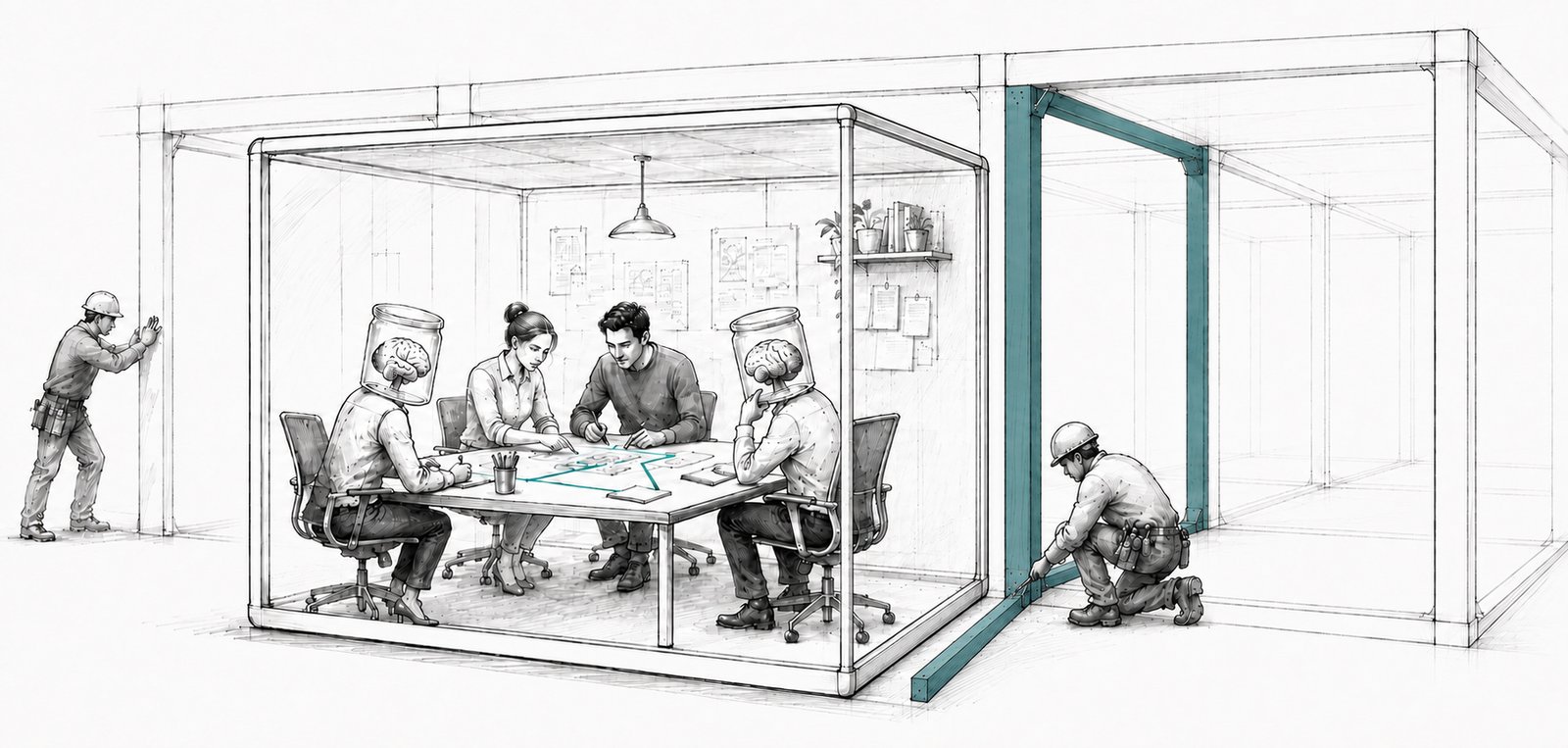
The synthetic space. The third is about where the work lives. Today most of us use AI alone, in our own chat window. The bigger change comes when AI joins the team, and the team has a place to work that it shares, builds on, and keeps changing. I call that place the synthetic space: led by human teams across the business, close to the work. Built with the technology teams, on new platforms and new approaches to requirements, design, architecture, security, and data. In it, a team can grow and shift what it is able to do inside the work itself. When it needs a contribution it does not have, the question is no longer only whom to hire, what software to buy, or which consultancy to bring in. It is what to assemble: a person, a synthetic role, or both, tried in days instead of planned for a quarter.
The result is a synthetic team: people and AI roles working together around one mission, with a person leading it. I think of it as a new building block for how a business works. People and AI work back and forth in a human and AI loop, with a person's name on the result. Running a synthetic space fits neither the way we manage people nor the way we run software. It needs principles from both. Over time, I think it becomes part of ordinary working life. Not in some cases. In how the business runs.
Better for more. The last is the purpose, and it has to be anchored in human dignity. It starts from something I believe before any argument: a person's worth comes before their usefulness. People are the point, not the technology. And AI can lift almost every part of the work: doing it better and faster, building better products and services, and making things better for customers and coworkers. So the question is how we create more of that value for people, in the work we do and then beyond the company, for society. An hour freed up is capacity, not cash. What we do with it is a choice, and the default choice is rarely the good one. I think this capability can reach people that today's arrangements don't reach, and I want to hold that ambition without apology.
Where it breaks
Our world is not set up to receive any of this. Each of the four runs into something we have built our habits and our organizations around. Those beliefs were reasonable when they formed. Many of them no longer hold, and I want to be specific about where.
As individuals, we assume more output is more good. Most of us still use AI as ask and answer. We get an answer, carry it back into the work ourselves, and start over next time. And AI now produces far more than any of us can read, check, or act on. Production outruns absorption. More output is not the same as more understanding, and the difference lands on the person.
As companies, we assume that if we give everyone AI, productivity will follow. And we pour the new capability into structures built on three older beliefs. That expertise is scarce, so decisions get rationed around the few people who hold it. That a process is hard to rework once software is part of it, so every change takes investment, time, and a project. And that work belongs either to a person or to a system, so there is no place for a team that is both. So we automate the process we already have, lock in the first answer, and measure adoption instead of what changed. The people closest to the work rarely get to shape it.
As a society, we assume two things that are not about the technology at all. That people will have time to adjust. And that the gain will find its way to the people whose work made it. When a job gets easier, the gain goes where it always goes by default, and the person whose work changed carries the risk. Picture a manager with an AI pilot plan, and across the table from her, a person whose work it may change. The company feels this uncertainty as more options. The person feels the same uncertainty as less time. And underneath it all sits an older belief still: that a person's worth is earned by being useful. Nobody has to be a villain for any of this to happen. It comes from ordinary, reasonable decisions made in separate rooms.
Those are assumptions, not laws. The work is finding out which ones still hold, and what it costs to keep the ones that don't.
How I think it should work
Here is the good news. We have an amazing opportunity to learn from history, including our own recent history. Getting from capability to value, and from value to human good, is not a new problem for us. We have crossed these bridges before. Let's build on where we've been.
In 1928, Alexander Fleming noticed something remarkable. Mold on a culture plate had stopped bacteria from growing around it. It was the beginning of penicillin, one of the most important innovations in the history of medicine. But a discovery is not yet a medicine. Fleming could not turn what he saw into something doctors could use.
In February 1941, Albert Alexander was gravely ill with an infection. Doctors at Oxford gave him penicillin, still experimental and so scarce that the team recovered it from his urine and gave it back to him. He began to improve. Then the supply ran out. The infection returned, and he died.
The treatment had begun to work. There simply wasn't enough penicillin to finish it. It took science, industry, and government until 1945 to get it into ordinary pharmacies in the United States. The capability came first. The systems required to make it useful came later. And people built them.
The second bridge has its own history. Ford introduced its moving assembly line in 1913. The time to build a Model T fell from about twelve and a half hours to ninety-three minutes. The value was extraordinary. The work itself got narrower and faster, and turnover reached 370 percent a year. Then the terms began to change. In 1914, Ford more than doubled daily pay, to $5 for an eight-hour day, with conditions that let the company look into how workers lived at home. In 1926, it adopted a five-day, forty-hour week, which helped make the weekend normal. None of that followed automatically from building cars faster. Workers, unions, other employers, and later the law helped write the settlement, and Ford did not sign a union contract until 1941. The production gain came first. The human terms took decades, and more than one author. That is a hopeful record. People changed the terms.
Many of us have lived through versions of this in our own working lives: the move to the web, to the cloud, to electronic records. Each time, the technology came first, and the real work was building the arrangements around it. We know how to do that work, and we have learned what goes wrong when we skip it.
I think we are at a similar point with AI. The capability is here, even if it is not yet dependable for every job. The systems around it, how we organize work, who gets to build, how decisions get made, were built for a different world. Crossing both bridges means rethinking them. The short version: manage AI like people, and govern it like a system, because it is not a person. Keep the core of the company steady, and let the teams closest to the work keep adapting.
Here is one example of building on where we've been. Ask a large company what stands between it and useful AI, and you will often hear that the data isn't ready. That answer comes from experience. Companies have spent years learning to manage data well: warehouses, shared definitions, governance, quality checks. That work is real, and AI needs it. The warning behind it is real too. AI built on bad data goes wrong fast.
What AI changes is the job we ask data to do. Data has fed forecasts and decisions for decades. But the data a business keeps on purpose is mostly its record, and a record is meant to hold still. AI draws on that record too, but it also needs context and lessons. Some are tactical, like which supplier's ship dates slip in December. Some are strategic, like why a process works the way it does, or why a decision went one way and not the other. That kind of data keeps moving. Some of it lives in emails, Excel files, and shared drives, not in the warehouse, and AI can now reach it where it sits. Much of it has only ever lived in people's heads.
You have probably heard that data is the new oil. Calling data oil says why it matters. It doesn't say what data does. Oil is something you extract, refine, store, and burn once. Data is logistics. Its value comes from moving: the right information, in the right shape, at the right moment, to the team that needs it, with its meaning and permissions still attached. That means capturing and managing the scattered pieces too, not only the official record, and even what people know but never wrote down. And unlike oil, data that gets used well comes back better.
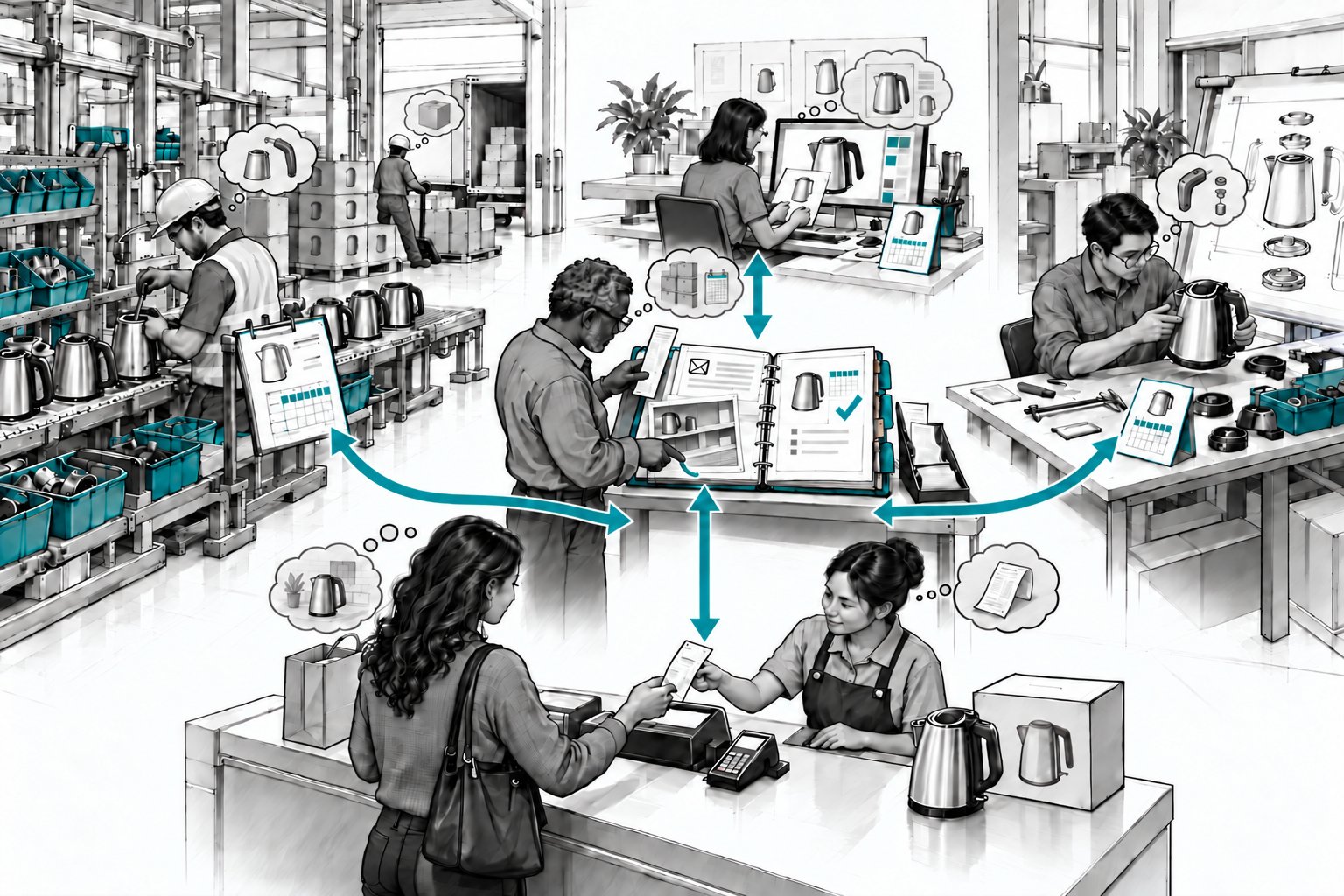
I think about data in three parts that work as a cycle. Supply is the facts, context, and definitions a team is allowed to use. Signal is what the live work reveals. Memory is the lessons worth keeping, including the reasons behind a process or a decision, so the next run starts from them. When the team learns a supplier's dates slip in December, that is signal. When the lesson is kept where tomorrow's run can find it, that is memory. When someone corrects the work and says why, the reason is kept too. And the next supply is better for it. I'll unpack this cycle in its own post.
So the plan doesn't have to be all or nothing, with everything moved and cleaned before AI can start. Start with the work. Use the strong foundations you already have. Harden what the work keeps asking for, and let the rest grow tier by tier. I think of data as logistics as the next step for the data work companies have already done, not a replacement for it. Penicillin's gap was not the discovery. It was everything needed to get it to the patient: making it, scaling it safely, and delivering it at the right moment. I think AI's gap looks a lot like that.
Data is one place where we can build on what we have. There are others: how a team built around a mission changes who gets to build, how fast a business can change when expertise arrives in a morning, how the rules can live inside the work instead of in a queue, and who gets the gain when the work gets easier. I'll take them one at a time.
Some of that I already believe. Some of it I'm still working out. I'll show my work either way, including where AI turns out not to be the answer.
What you'll get
This LinkedIn newsletter is where I'll share perspectives on AI, trends, and what it means for individuals, businesses, and society. It's where I'll explore the promise of AI and work through the two bridges: how capability becomes value, and how value becomes better for people. Follow here on LinkedIn for those.
Alongside it, AI Above the Cut is a weekly email for leaders who want to make sure they catch the biggest AI headlines every week. It shares the week's news worth knowing: the news above the cut, what it means, and what to watch. I'll bring the highlights here.
One of the stories coming up: the Saturday I asked AI for a local newsletter before leaving for a basketball tournament, and what that weekend turned into.
One question to leave you with, and I'd love your answer in the comments: Where do you see the gap between what AI can do and what your organization actually gets from it?
Mario
Illustrations created with AI, directed by the author.
Have a view on this? Join the discussion on LinkedIn →
Get the Sunday brief
Free, every Sunday. What changed in AI, what the evidence supports, and who keeps the money it makes.
Subscribe →