OpinionThe Editor's Cut
AI and the Citizen CEO
What changes when one person can put a team around an idea?
This is an opinion piece. The sourced news brief for that week is Issue 019: AI is finding security flaws faster than we can fix them.
Also published on LinkedIn, where you can join the discussion.
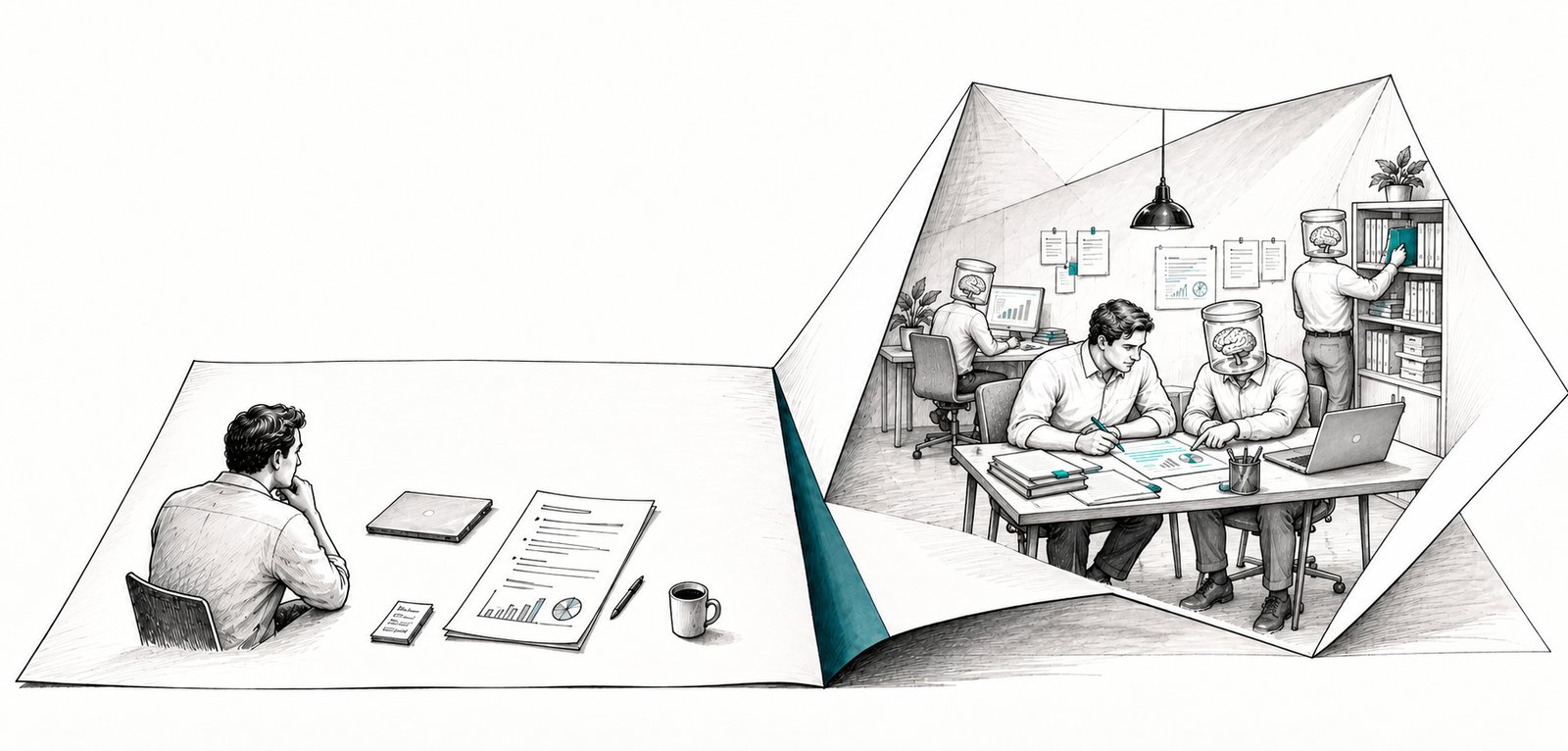
Ask any manager what they would do with one more person on the team, and they will have an answer ready. Go deeper on the work. Give customers more attention. Get ahead of problems instead of meeting them on arrival.
You probably have an answer too. Something you understand and care about, at work or at home, that you've never had enough help to do properly.
For most of us, putting a team around that work meant finding people, finding a budget, and finding time. Plenty of worthwhile ideas never got that far.
AI is changing that. We've learned to ask it for an email, an image, or an answer. Now we can bring those capabilities together around something larger: expert roles working together toward a shared goal, and the process, software, and data they need, built as the work goes.
You can work alongside that team: share the materials, look at what comes back, and change what happens next. As you learn what the work needs, you can develop the roles, the process, and the technology together, in hours rather than quarters. Something you wished you had a team for may now be something you can begin.
This is where I see the opportunity for AI to bridge from capability to value: through the Citizen CEO. Not a person with an assistant, or an agent that executes a job, but a person who can build a capability on demand and keep shaping it, around a purpose they understand, whether it serves their family, their community, or the people they work with.
- The capability is here now. It worked for my inbox in an hour, and it has run a newsroom every week since June.
- The power to build and iterate is real, and it's open to anyone who understands their own work. Nobody to hire first, no software project to fund, no code of your own to write.
- What it unlocks is a dynamic capability. Your judgment, AI roles, a process, software, and data, set up and changed at will to deliver a result. And with it, the chance to be the author of work you were only ever allowed to ask for.
Let me show you what I mean, starting with something I tried and failed to build.
What AI can do changed this year
Around 10 years ago, I started emailing myself interesting items for future reference. Articles about healthcare, current events, coaching, and eventually AI, all to one address I set up for it. Easy habit. Also a very good way to build years of material I wanted to keep track of but never looked at again.
In mid-2025, I was in the midst of exploring AI and thought this was the perfect use case: AI could finally help me manage this inbox. I would need it to read my emails and capture the source content from a mix of links and text. I asked a few AI chats how I could do it. They each gave me a plan. I cross-referenced the plans and followed the instructions step by step: set up this low-code tool, now this vibe-coding tool, now LangGraph. The AI knew what to do. I was the one who couldn't do it. After several hours each weekend over a few weeks, I accepted I was beyond my depth and let it go.
The AI had given me a reasonable plan for someone with the right patience and skill. Regretfully, I was not the person who could carry it out.
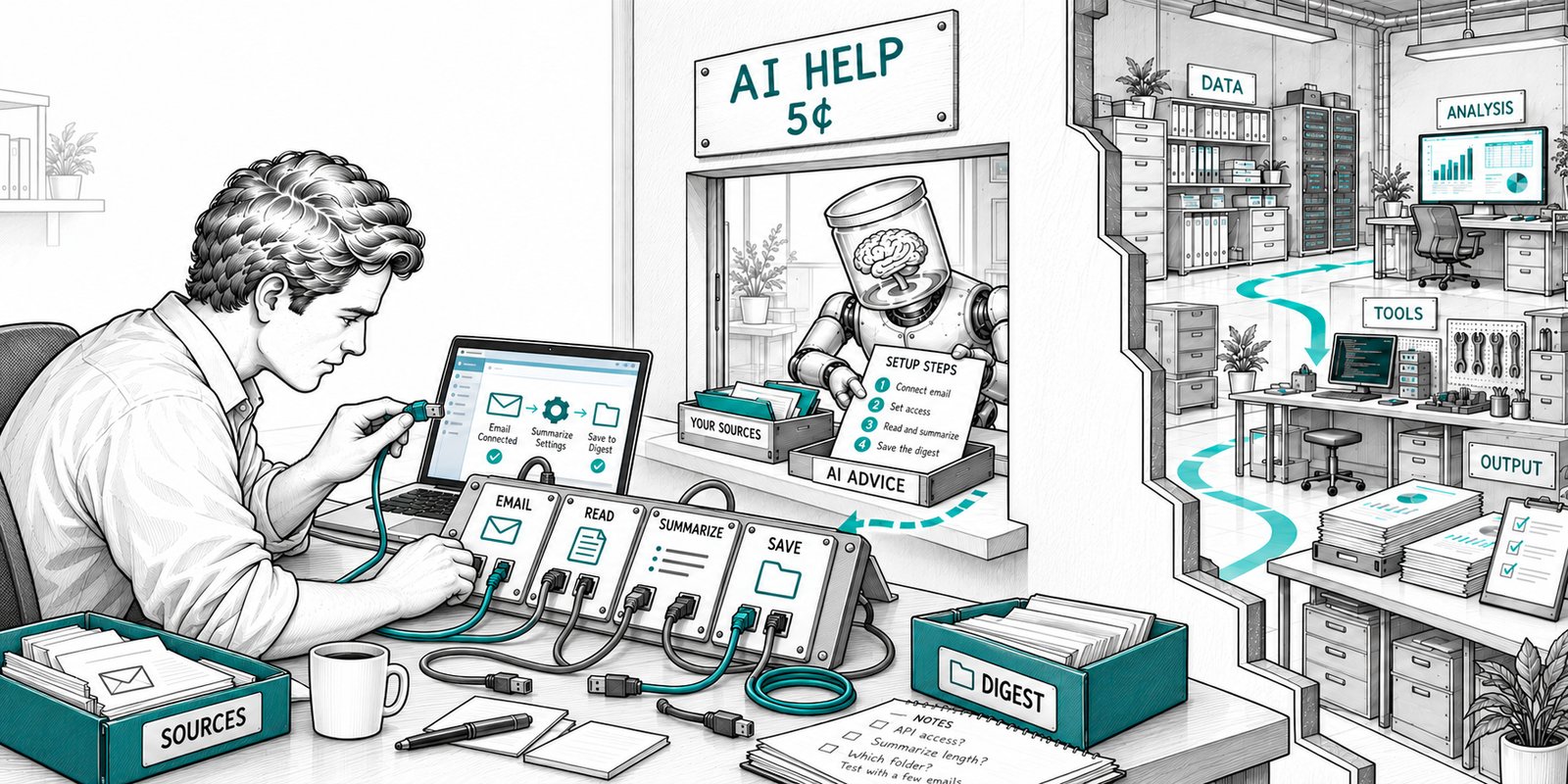
In early 2026, my AI reading was flooded with people raving about Claude Cowork (whose capabilities Anthropic has since folded into Claude itself), and I decided to take another shot at this idea. I set up a project called Reading Digest, connected my email, and described the outcome I wanted via a voice prompt. It asked whether I wanted a prototype. I said yes.
It worked on the first attempt. Within an hour or so it was sending me a digest twice a week with an editorial on top, and working back through ten years of email in batches.
My technical skills did not improve between the two attempts. I did not get smarter, and I certainly did not get more patient. The first time, the AI answered with a plan. The second time, it just did it.
The starting point has moved: AI is more capable and more usable.
What changed underneath
Let's explore two ways to explain what changed between my two attempts: a practical one, which puts it in plain terms, and a technical one, which looks at the technology behind AI.
First, the practical answer
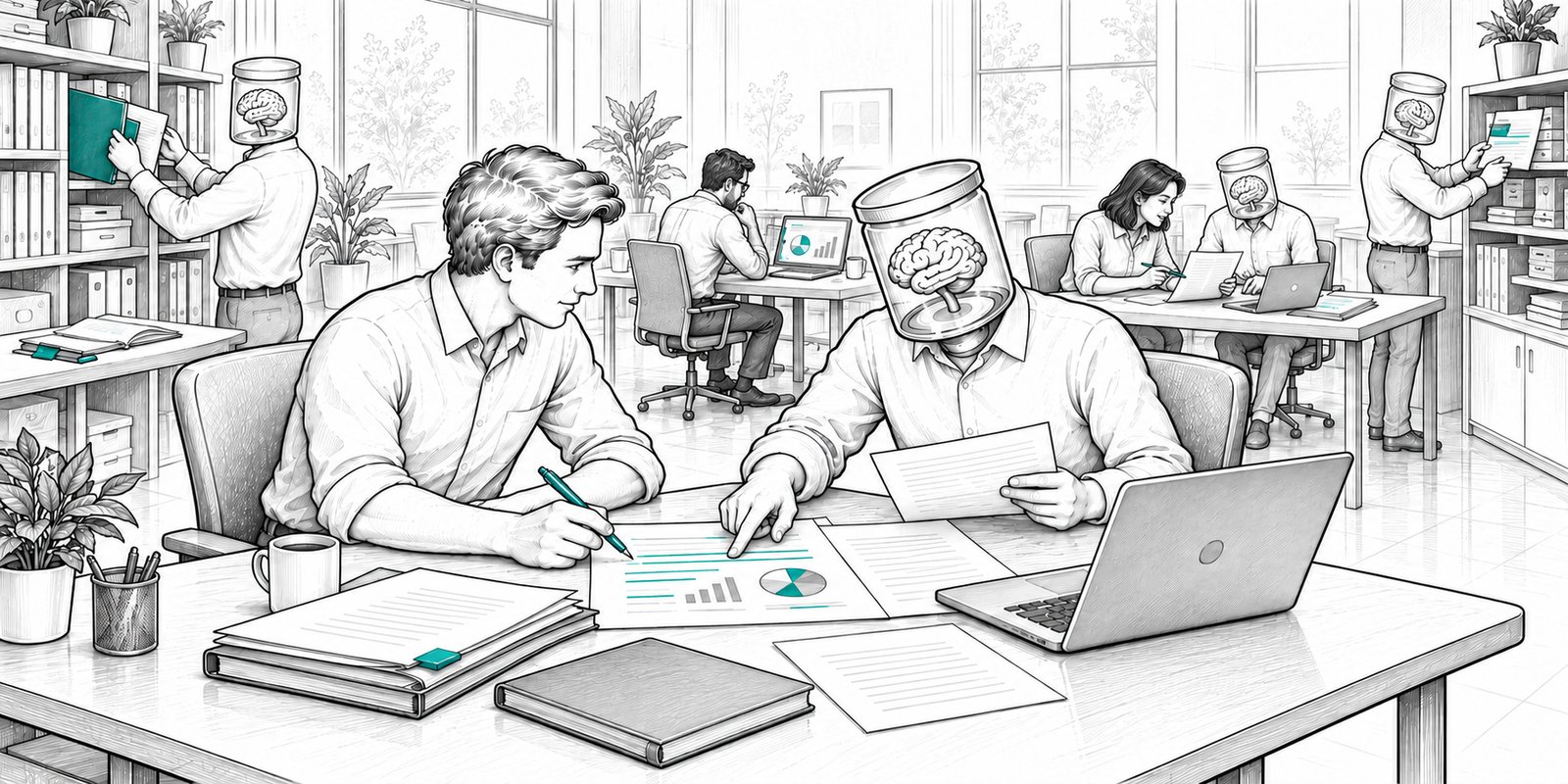
Here is how I would describe what changed: AI now sits across the table from us. In the same room. When we work with a person, we discuss objectives, divide the work, then come back together to review what we built.
In 2025 that wasn't how it went. AI lived in a chat window. You made an ask, got an answer, and carried it back into the work yourself. You were the swivel chair between AI and the job, and the swivel chair was most of the cost.
Let's put it side by side. Picture you and me working together on a project.
- You send me a draft and a plan. I ask about a paragraph and about your approach, and you answer on the spot.
- We agree the plan needs an expert you don't have, that one handoff keeps dropping things, and that the technology has to change for the work to run without a workaround. So you go back to your team.
- A few weeks later you're back. The expert is looped in. The handoff is fixed. The tool change is in the queue for early next year.
- We review it together and go again.
Now the same project with AI.
- My AI team sends me a draft and a plan. I press the microphone button, screenshot a paragraph, ask about the approach, and it answers on the spot.
- We agree the team needs a role it doesn't have, that one handoff keeps dropping things, and that the technology has to change for the work to run without a workaround. So it goes back to the team.
- Thirty minutes later it's back. The role is written and in place. The handoff is fixed. The tool is changed, though I'll have to see if it works.
- We review it together and go again.
Then, the technical answer
Three things stand out: the brain got more capable, it got connected to your world, and it got packaged so that you can use it.
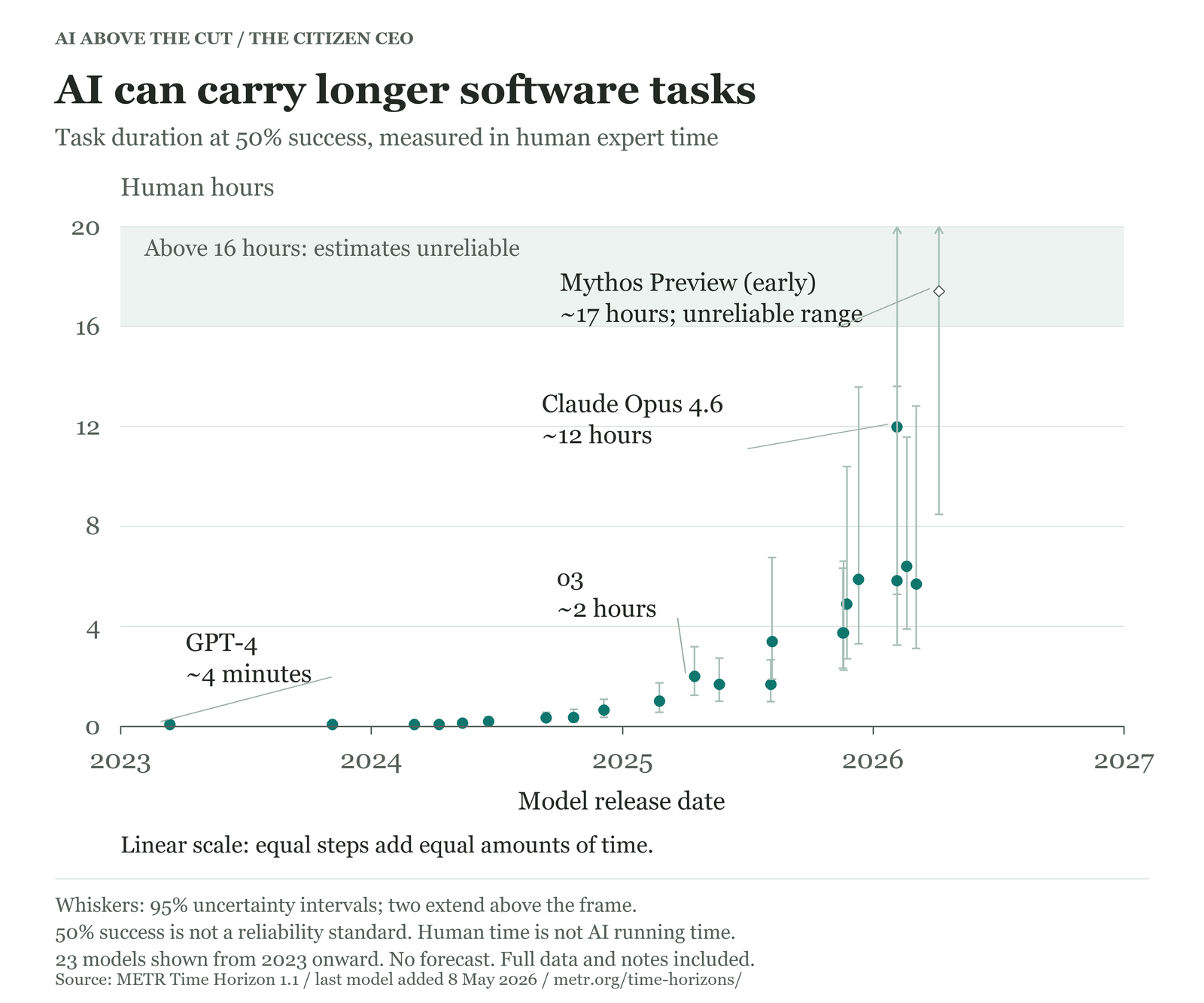
The brain got more capable. If you've been to an AI talk this year, you've seen the chart for this. If you've been to two, you've seen it twice. METR, a research group, tracks the software tasks AI completes about half the time, measured by how long a skilled person would need. Three years ago, minutes. Now, most of a working day. Software work, not whole jobs. Read the slope, not the last dot.
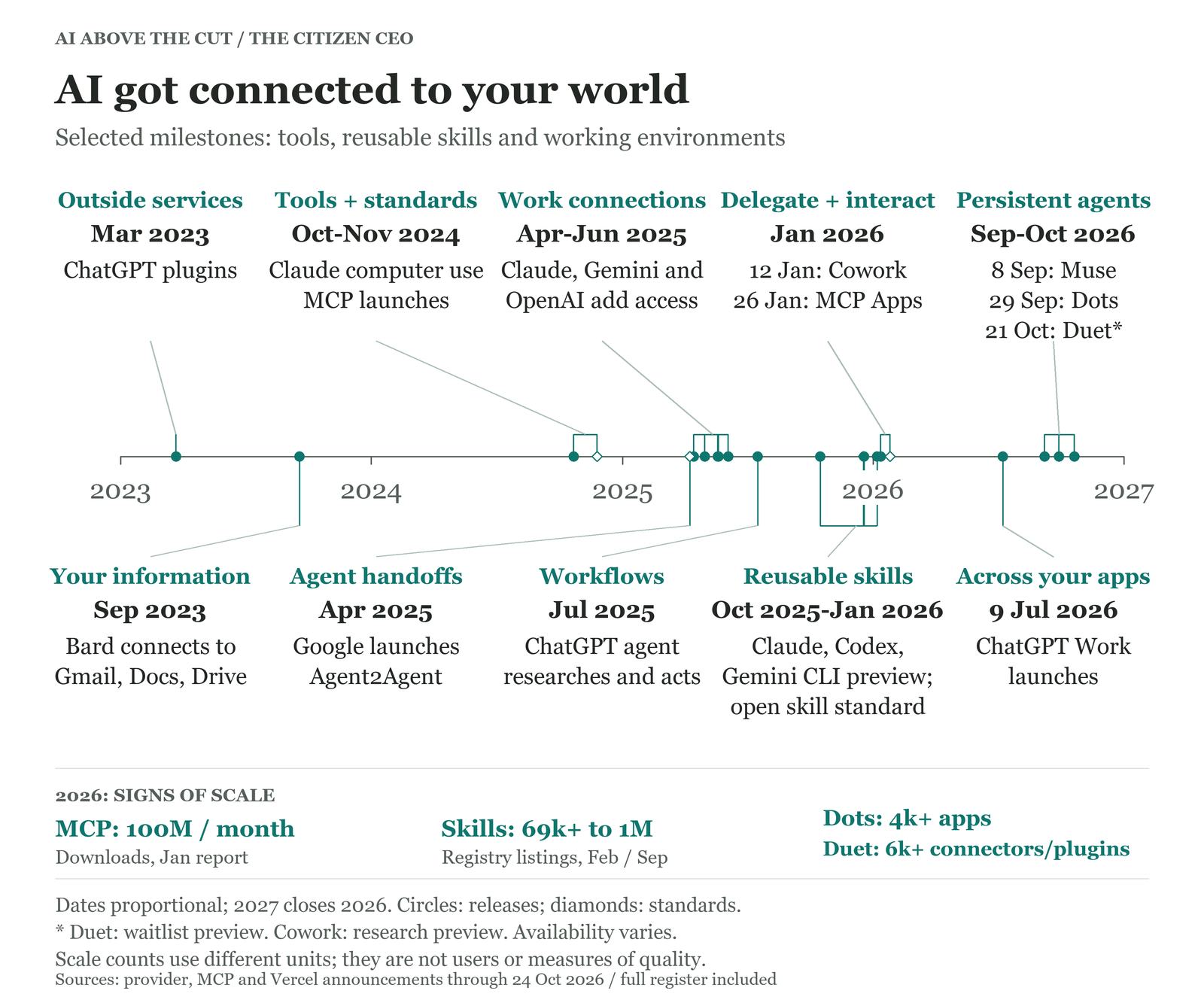
The brain got connected to your world. A model on its own is a brain in a jar. It can think and talk, and that's it. The industry has spent three years building the connections: to your files and email, to skills it can reuse, and to a shared standard called MCP so tools from different makers plug in the same way. The jar is still a jar. But now it has hands and eyes.
The brain got packaged so you can use it. The industry's word is the harness: everything around the model that keeps working notes, holds the plan, and hands work between roles. Below, the same model scores very differently in two setups. Read Google's gap with care, since its plain run didn't finish, but the direction is the point: the same brain, in a harness designed for it, performs like a different one. And it's what makes the brain usable. A smarter brain with more tools only reaches you if it comes in something you can sit down at. I wrote about it in last week's edition.
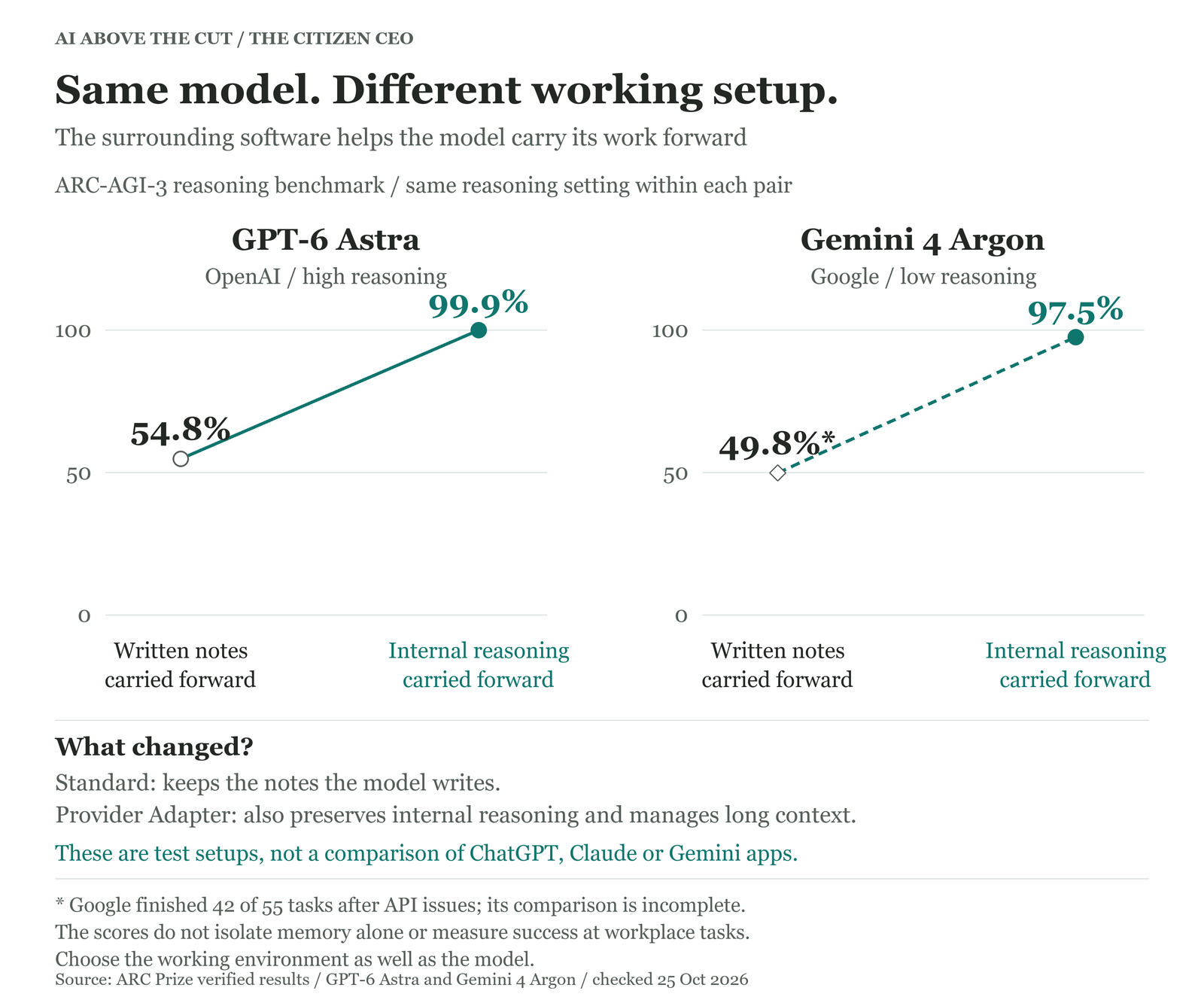
Put those together: a more capable brain, connected to the place the work happens, in a container that keeps track of the job. That is why my second inbox attempt took an hour.
Once I saw it work for my email, I wondered what would happen if I pointed it at a bigger job and asked it to build a team. The best example I have is the newsroom behind my weekly newsletters.
The newsletter CEO and team
AI Above the Cut did not start as a newsletter about AI. It started as a neighborhood newsletter, on a Saturday morning, before I left to coach a basketball tournament.
My family, like many, is often running from one event to another. When we get a free night or a weekend, we want something fun, easy, and affordable, and some weeks it felt like we spent more time looking for something to do than doing it. AI turned out to be a convenient place to ask: "I'm looking for something to do tonight with my 17-year-old daughter, 13-year-old son, and 6-year-old son, somewhere nearby." It helped, and we kept using it. Unless we got lucky, like the time we found the Scottish festival by accident, it seemed we only found out about the good stuff after it was over. My wife and I had said it more than once: somebody should put all of this in one place. That triggered an idea: maybe AI could set this up for us, so it just kept coming. I was curious what it could do. This time I thought, why don't we try it?
One Saturday, before leaving for a basketball tournament, I sat down at home and asked AI for a weekly newsletter of things worth doing around Ashburn. I wanted to see if I could create an agentic team. So I didn't ask for a recurring list of events. I asked for a newsletter, and to have a newsletter, I asked for a newsroom: a librarian to track sources and a writer to produce the issue, a team that could produce it and keep producing it. Looking back, it was the decision that mattered. I didn't just ask for a newsletter. I asked for a newsroom, and the newsroom is what I have been able to keep improving ever since.
The team was in place in less than an hour, though its first draft wasn't very good. Restaurants, concerts, family activities, and festivals had all been researched as one job, so the coverage was random. The formatting and style needed work.
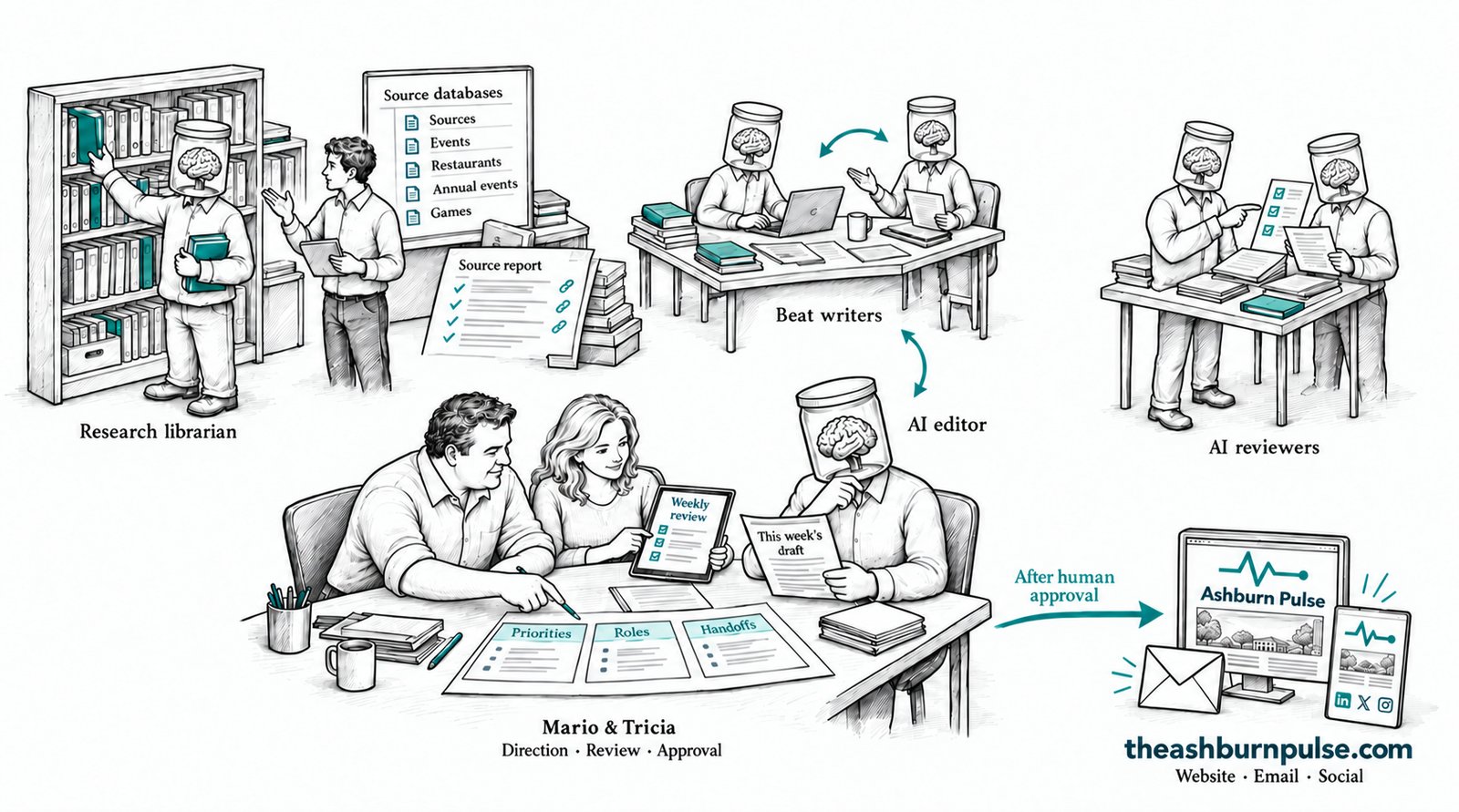
So I adjusted the team and the process. I added beat writers, each on a beat, and an editor to decide what belongs. I gave it guidance on formatting, style, and tone. I asked for options on branding, and we picked a name, fonts, and colors. Then I left for the tournament.
I returned to my budding newsroom that evening. This part was much harder. While AI could control my PC, I still needed to do much of the work to bring it into the world: a website, a mailer, the plumbing that carries an issue from my machine to the web and inbox. I completed the setup by the time I went to bed.
Ashburn Pulse published its first issue on June 13. Since then, the roles and process have evolved, adding quality checkers for links and accuracy and synthetic readers to improve a draft before it reaches me. Now the newsroom passes an issue to my wife Tricia and me every Monday. We approve or adjust the events, then stage the issue for mailing on Tuesday nights.
I don't intend for this to sound effortless. The first issue was bad, and the setup ran until bedtime. I also had a head start, and it wasn't about the tools. My years as a consultant, and my experience using AI at work, had taught me to think like a manager rather than a contributor: what roles the team needs, how they hand work to each other, how I'd hold them to a standard, what they need to be set up with, and how the information gets managed. That is what I brought to the Saturday prompt. You don't need to bring all of it. AI proposed most of the roles and the process once I asked for a newsroom, and the first issue told me what to change. But I didn't write code or engineer a pipeline. I described what I wanted in plain English, on a Saturday, around a basketball tournament. The threshold has fallen a long way. Building something dependable still takes judgment and iteration, and that judgment comes from understanding the work, not from knowing the tools.
Then came something I hadn't planned for, and it was a pleasant surprise. A week or two in, I wanted a newsletter to keep myself current on AI news. The obvious move was to start over with a new prompt. Instead I asked AI to look at what we had built for Ashburn Pulse, pull out the parts that weren't about Ashburn, and set them up again for a different subject and a different reader. It came back with the same shape of team: a librarian, researchers on beats, an editor, checkers, and the plumbing to publish. I pointed it at AI news, gave it a style, and AI Above the Cut launched a week after Ashburn Pulse. The AI Above the Cut weekly mailer is my neighborhood newsroom, adapted to a new subject and a new reader.
In August I did it a third time, for a newsletter where healthcare and AI meet. I called it "Dr AI." The name is playful. The team behind it isn't: a research desk, an editorial view, and a quality gate I'd trust in front of a paying reader. The three share one library and one research engine. Each has its own writers, editors, and rules. And last week I did it a fourth time, at my day job: an internal newsletter for the business areas I work with, on how they're getting ready for AI and what is actually landing. Inside a large company it's easy to get lost in what we've already decided to do. This one gives me an outside view, with very little effort. Its first issue cited 86 documents.
That's when I understood what I actually had. Not a newsletter, and not just a collection of newsletters. A newsroom I could point at any subject, adjust while it ran, and copy when I needed another one. I never built a system first and then used it. I described the outcome, and the machinery the job needed took shape underneath it as I worked. Each newsroom now has its own database of sources and reviews, its own checks, and its own publishing system, all built by the team as the work called for them. I don't touch the code behind any of it. I judge the machinery by what it produces, and I change it by giving feedback. If I have none, it keeps running. We no longer have to build the software ahead of the work. When I want a new beat, I add a researcher. When a check runs too late, I move it. When Tricia wants the events sorted differently, the editor learns the rule. None of that means starting over.
Counting Reading Digest, that's five publications this year, each built on weekend hours, and each taking less time than the one before.
"You know, for kids!"
There's a scene I keep coming back to when I try to explain what happened on that tournament day.
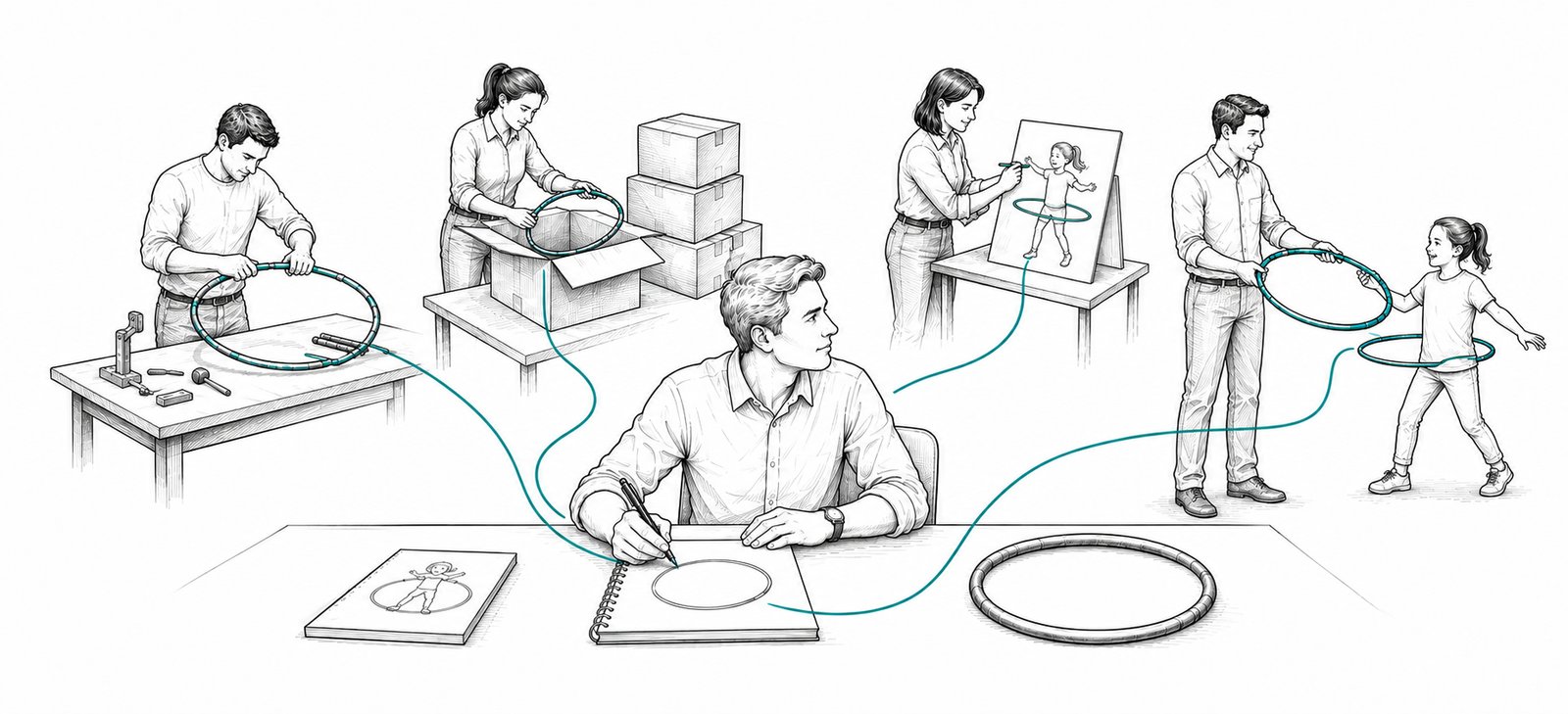
In the Coen brothers' film The Hudsucker Proxy (spoilers for a 32-year-old movie ahead), a mailroom clerk named Norville Barnes keeps showing people a drawing. It's a circle on a piece of paper. "You know, for kids!" he says. People smile and nod. Nobody knows what the circle is, and most of them think he's a little nuts.
The board, hoping to drive the stock down so they can buy it cheap, makes him president and expects him to fail spectacularly. The scheme backfires.
The circle is a hula hoop. Overnight, Norville has a company behind his idea. Designers, an ad department, accountants, a factory. The idea nobody understood on a scrap of paper becomes real almost by accident, because someone handed him an organization that could act on it.
That gap between seeing an idea and having the means to act on it is the one most of us live with. AI is handing a much wider group of people something like what Norville got: the ability to put a team around an idea they can already see. Not a company. A team, assembled in an afternoon, around a purpose they understand.
The Citizen CEO
That is what I mean by Citizen CEO, and I chose both words on purpose.
Citizen is about access, and about how broad it is. This is not a capability for the few. You don't need to hire anyone, fund a software project, or write code. If you can describe work you already understand, you can run a team around it, or a capability, or even a small business.
CEO means three things here.
The first is that what you're building is more than a vibe-coded app. It's a functioning team: roles with jobs, a process that runs every week, and handoffs between them.
The second is the authority that comes with the title. A CEO decides who to hire and which software to invest in. You can now make both of those calls for your own work, on demand, at a cost you can afford. That is what makes the access real.
The third is the hard part, and it's where the value gets unlocked. It's a way of thinking: mission over task, and a repeatable capability over a brilliant expert. AI is smart enough that if you ask it to do one thing and work with it, it can usually do it. For my family's weekly list, I could have saved a prompt, built a custom GPT, written a skill, or asked Dots or Duet to run it every Thursday. All of those would work, and each would hand me a result. What I wanted was a capability: something I could inspect, correct, and keep improving toward a mission. For this work, that meant distinct roles with handoffs between them, the same way it would with people.
So my hypothesis is that AI becomes far more useful when you manage it like a team with a mission than when you keep asking it for tasks. With Ashburn Pulse, the mission is one useful issue a week. Each issue tells me where the team is short. When a broken link showed up for the second time, I didn't fix the link. I moved the check earlier, and every issue since has arrived already checked. I fix the team, not the issue. A repair fixes this week's output. A capability changes what happens next week and every week after. That is why the word is CEO. The job is to think like the person responsible for a team that can deliver, not only like the person doing the work.
Three things follow from that, and if you read my first edition you'll recognize all three. This is what they look like up close.
The first is the team itself. I call it a synthetic team: AI roles working together through a process, with a person responsible for the result. A human and AI loop, with a person's name on the result. It's what you get when you stop asking for tasks and start staffing a mission.
The second is the place that team works in. Working with that team isn't quite like managing people or using conventional software. It has some of the character of each, and patterns of its own: it learns a correction the way a team does and runs the way a system does, with strengths and weaknesses that match neither. The tools we have were built for one or the other. A team on a mission needs a place built for both, and I call it the synthetic space. It's where the new rhythm of work happens: bring in expertise in the morning and rebuild the process in the afternoon.
The third is what it unlocks. Remember the question I opened with, what you would do with one more person. This is the answer to it, and it's open to anyone who understands their own work. That is the chance to pursue better for more.
That's how I work with these teams. I tell them what the work is for and what good looks like, help shape the roles and handoffs, judge what comes back, and change what isn't working. The conversation isn't the product. The conversation directs the work. Management became the interface.
And through all of it, the pen stays with you. You decide what the team is for, what good looks like, what goes out under your name, and when to stop. But notice what else you get. Agency. The Citizen CEO gets to write their own story, as one person at home or as one person inside a company, and to build the team that makes it real. The AI is cheap to buy. What it puts in your hands is not. I call that authorship: we all have the chance to author part of the future, with the pen in our own hands. Norville Barnes could never have made the hula hoop alone. He happened to be made CEO of a company, and his idea came true. With AI, it no longer takes an accident. What potential does that create?
And you don't have to run a team to take part. Some will use AI for a task. Some will build and run a team. Some, like my wife Tricia with Ashburn Pulse, will supply the judgment that changes its work without ever opening the tool. All three are real ways to take part.
Where does this take us?
My story is a story of use at home. The real question is what's possible when this crosses into a company, where there are many teams, many missions, and someone else's rules.
Who gets to be a Citizen CEO? Only people improving their own lives on a Saturday, or people inside companies too? A manager in marketing? A vice president of finance? A new hire in operations who sees a problem everyone else has learned to work around? Each knows something about the work that never makes it into a project proposal.
What would they need? Access to tools and information, room to learn, and clarity about what they can change and who remains responsible. And what part do the technology, data, and governance teams play in making that possible?
And what should they aim for? Producing more is capability. The value is in what the work improves, and the human good is in what changes for the people doing the work and the people it serves. Those are the two bridges: capability to value, and value to human good. In my first edition I called the far side of those bridges better for more: more people with more room to act on what they know.
Time to catch the wave
William Wolf, a founder who spends a lot of time between New York and San Francisco, put it in one line this month: "AI is the water in SF." Silicon Valley is the epicenter of this. It's home to NVIDIA, Google, Anthropic, and OpenAI, and what's taken for granted there still sounds foreign almost everywhere else. It was the Gold Rush once. This time it's the AI rush, and the moment is now.
So give it a try. Even if you start with Dots, Duet, or Muse and ask for one thing every week, you'll start to see what it's like to work with AI rather than ask it for something. Then take a shot at being a Citizen CEO. The access is open to you. Bring in the expertise and the software on demand. Form the team. Give it a mission, not a task. Build the capability, look at its first attempt, tell it what was off, and see whether the correction holds next time.
My wife and I still read every issue. What changed is that there is now an issue for us to read, and a team we can keep improving around it.
I'd love your answer in the comments: What is one responsibility you already own that you'd put a team around if you could?
Mario
Have a view on this? Join the discussion on LinkedIn →
Get the Sunday brief
Free, every Sunday. What changed in AI, what the evidence supports, and who keeps the money it makes.
Subscribe →